It was William Osler who defined pneumonia in his book The principles and practice of Medicine as “the friend of the old man”.1 This was at the end of the 19th century, and we could infer that this description reflected his perception of it as a natural cause occurring in old age. An end-of-life event that, at that time, could be interpreted as the incompetence of the immune system in the face of infection in an era when antibiotics did not exist. The arrival of antibiotics marked a milestone, altering the natural course of the disease. The immunosenescence of elderly patients was reinforced by molecules that, when properly administered, overcame death. Pneumonia ceased to be the “friend of the old man” with the advent of antibiotic therapy. However, more than 100 years after William Osler’s publication, there are studies supporting his theory, documenting in this age group, despite antibiotics, a high short-term mortality associated with pneumonia, even among those who survive the acute episode.2
After antibiotics, vaccines modified the natural history of pneumonia, reducing its incidence rate and attenuating its clinical expression, preventing the development of more severe clinical forms. A recent example is the success of vaccination against COVID-19, which has saved millions of lives.3
In this historical trajectory of interventions that changed the clinical course of pneumonia, mechanical ventilation must be highlighted. This intervention demonstrated its ability to save the lives of patients who develop respiratory failure by ensuring adequate oxygenation and elimination of CO₂ when patients are unable to maintain adequate spontaneous breathing. Paradoxically, this treatment represents both a therapeutic solution and a factor associated with the development of pneumonia. Therefore, the Spanish Society of Intensive and Critical Care Medicine and Coronary Units (SEMICYUC), developed more than a decade ago the Neumonía Zero project, within the successful patient safety strategies promoted to reduce the incidence rate of health care-associated infections, particularly ventilator-associated pneumonia, with proven clinical results.4 Currently, ventilator-associated pneumonia remains, for decades, the leading health care-associated infection in ICUs. In the study published in this issue by Claverias et al., the effectiveness of one of the measures of the project is questioned: the administration of antibiotics within the first 24h of admission in patients with decreased level of consciousness. The authors found no differences in the development of ventilator-associated pneumonia.5 These results should be interpreted with caution, considering the limitations already described by the investigators themselves, both in the study design and in the setting where it was conducted. From a clinical perspective, it is not easy to distinguish in intubated patients with reduced consciousness between pulmonary aspiration and ventilator-associated pneumonia, and it could be debated whether this distinction would change therapeutic management. Although aspiration would radiologically be more pronounced in right basal segments, this finding alone cannot be considered a robust criterion for differential diagnosis. On the other hand, we know that microbiological isolates in aspiration pneumonia do not differ from those in ventilator-associated pneumonia occurring within the first week. We must also add to this debate the importance of the quality of respiratory samples and the fact that the yield of microbiological cultures is variable. Molecular diagnostic techniques point toward advances of great interest in this field.6 The antibiotics used in the study were considered equivalent in the treatment subgroup, despite not having the same ecological impact. Therefore, in this preventive strategy, antibiotics with anaerobic activity cannot be considered equivalent to those without such activity when the authors include in their conclusion the appropriate use of antibiotics in the context of resistance. Nevertheless, it is debatable, in the absence of data to support it, whether a single dose of antibiotics at the time of intubation truly impacts the emergence of bacterial resistance. It is more plausible that resistance develops due to prolonged unnecessary treatments at inadequate doses or dosing intervals. In patients with decreased level of consciousness, after aspiration of respiratory secretions or gastric contents, chemical pneumonitis or aspiration pneumonia may occur. The symptoms of the latter are not expressed immediately and may take up to 48h to appear, making it sometimes difficult to distinguish from the onset of ventilator-associated pneumonia. Administering antibiotics at the time of intubation in these patients involves divergent possible pathophysiological arguments. On one hand, it may be considered a preventive measure against ventilator-associated pneumonia, assuming that such administration will mitigate the growth of bacteria present in the upper respiratory tract that have reached the lung parenchyma through the orotracheal tube. On the other hand, it may be considered empirical treatment of aspiration pneumonia, where early administration is key to preventing further deterioration of the lung parenchyma in the initial phase, when the inoculum is higher.
In any case, many other factors influencing pneumonia prognosis must be considered. If William Osler pointed more than a century ago to immunosenescence in the elderly, we must also consider what occurs in younger patients, in whom the inflammatory response is exacerbated. It is necessary to begin considering that not only bacterial injury triggers this activation of inflammatory mediators. The reason for ICU admission, patient comorbidities, and even mechanical ventilation itself condition this inflammatory activation, which must be modulated if we are to move beyond antibiotics in pneumonia treatment. There are studies demonstrating that the mode of ventilation induces different inflammatory responses depending on the ventilatory parameters used.7,8 The difficulty lies in the fact that severe pneumonia is not treated solely with antibiotics and mechanical ventilation while waiting for recovery. It is necessary to begin addressing how to modulate this host immune-mediated response, which we know may be diminished in very elderly patients but may present at the opposite extreme in other patient types. Moreover, this response is not static during the course of pneumonia, requiring a dynamic approach to the disease, taking into account that host response and even daily ventilatory requirements influence the release of inflammatory mediators. This need for treatment personalization may explain the lack of conclusive data in studies attempting to demonstrate the benefits of immunomodulatory therapies, including corticosteroids, in a generalized manner, with heterogeneous results regarding prognosis.
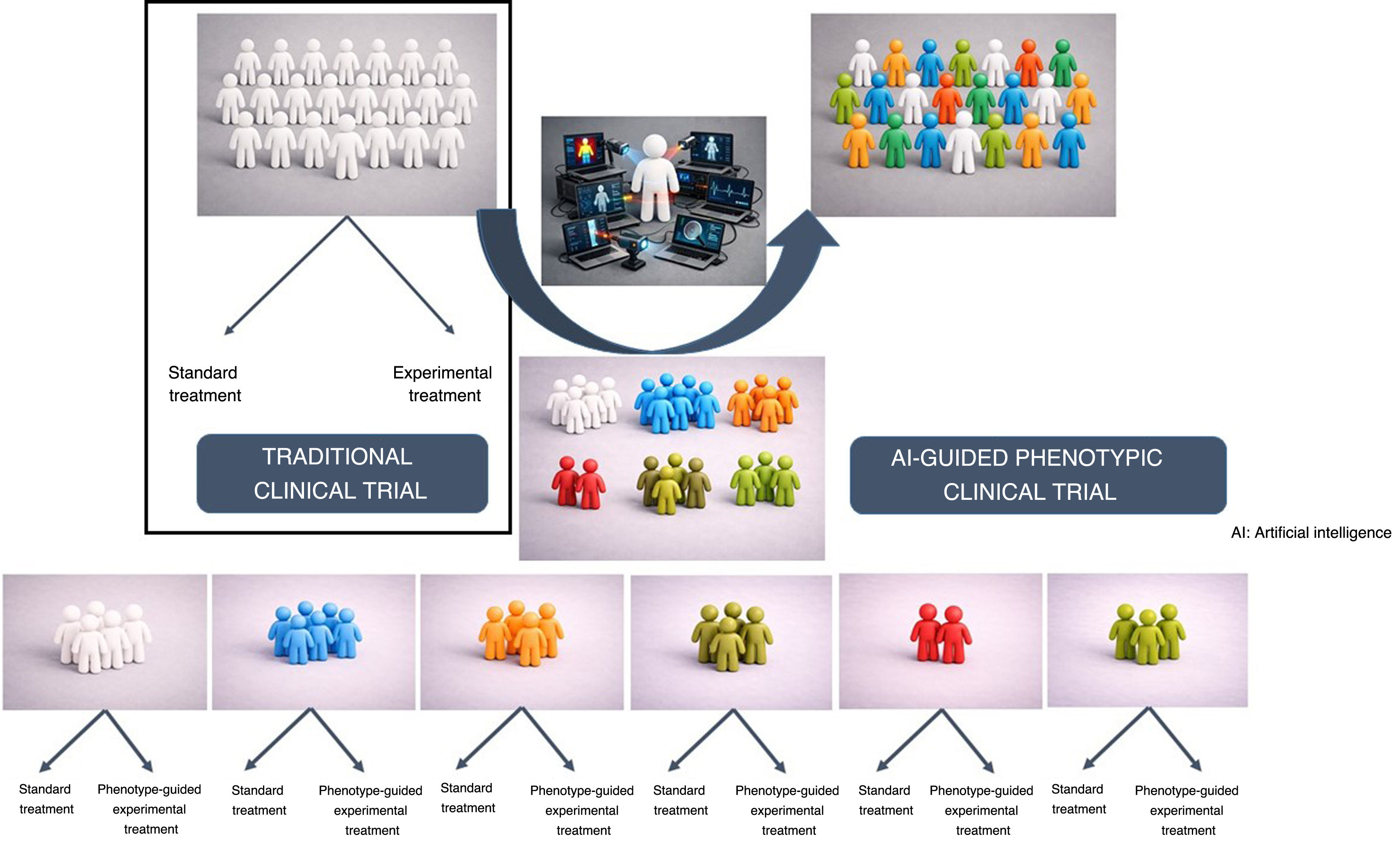
Individualizing treatment is the challenge of our time. Defining patient profiles that express specific subphenotypes dynamically requires data processing that integrates clinical, hemodynamic, ventilatory profiles, other supportive treatments, concomitant therapies, and laboratory findings to determine, at each specific moment, which strategy—beyond antibiotics—would complement optimal medical therapy. Classical clinical trials will need to be replaced by AI-guided phenotype-guided clinical trials, in which the treatable trait is considered—a measurable patient characteristic that is a causal or contributory determinant of clinical outcome and could plausibly be modified by intervention. This therapeutic approach oriented toward phenotypic profiling of critically ill patients is feasible and may provide a pathophysiological explanatory basis that offers coherent answers to studies that have thus far been contradictory or inconclusive (Fig. 1). It is likely that machine learning tools and AI will not only help in identifying these patient profiles but will also provide other opportunities already documented, such as reducing the duration of mechanical ventilation.9 Ultimately, the best way to prevent ventilator-associated pneumonia is to discontinue, as soon as possible, this “young friend” of the disease—the mechanical ventilator.
Authors’ contributions
Ángel Estella authored the manuscript.
Declaration of Generative AI and AI-assisted technologies in the writing processAI has been used to design the figure in the manuscript.
FundingNone declared.
None declared.