
Severe respiratory failure, especially acute respiratory distress syndrome, is a common clinical condition in Intensive Care Medicine. This disease represents a significant proportion of admissions to ICUs in any hospital, regardless of its level of care. Therefore, it is essential to standardize its management and ensure that all patients receive equal therapeutic opportunities.
The latest European1 and American2 clinical practice guidelines recommend the use of protective mechanical ventilation (MV) with low tidal volume to minimize ventilator-induced lung injury (VILI), as well as the implementation of prone positioning when hypoxemia reaches a certain threshold, with a strong level of recommendation. Furthermore, they suggest, with lower levels of evidence, the use of neuromuscular blocking agents and corticosteroids, and for the first time introduce recommendations in favor of extracorporeal membrane oxygenation therapy in the venovenous configuration (V-V ECMO) in cases refractory to the previously mentioned measures (protective MV, neuromuscular blockade, prone positioning).
Hospital Universitario Miguel Servet (HUMS) in Zaragoza (Spain) is the ECMO referral center in the Autonomous Community of Aragón, with an established V-V ECMO program since 2016. All patients in the region, from both public and private healthcare networks, with indication for V-V ECMO therapy are evaluated and managed by the HUMS ECMO Group and transferred to the Referral Center.
In this study, we analyzed 1-year survival after ICU admission and the prognostic influence of factors described in the literature in patients treated with V-V ECMO since the beginning of the program. Therefore, we aim to provide real-world data to help other groups evaluate or plan similar programs, particularly in regions with comparable health care structures. We conducted a prospective, observational cohort study in consecutive patients treated with V-V ECMO at HUMS from August 2018 through January 2024.
The clinical and gasometric criteria used to indicate or contraindicate V-V ECMO therapy are those defined in the EOLIA study,3 which were incorporated by the Extracorporeal Life Support Organization (ELSO) in 20174 and adopted by SEMICYUC in 20185 (MES).
Prior to V-V ECMO implantation, neuromuscular blockade was initiated in all patients, and unless contraindicated, at least 1 prone positioning maneuver was performed. After initiation of therapy, protective MV6 was maintained in all cases (Pm < 30 cmH₂O, driving pressure (DP) <15 cmH2O, and FiO2 <50%), and an ECMO-awake strategy was attempted with withdrawal of neuromuscular blockade within the first 48–72 h after therapy initiation.
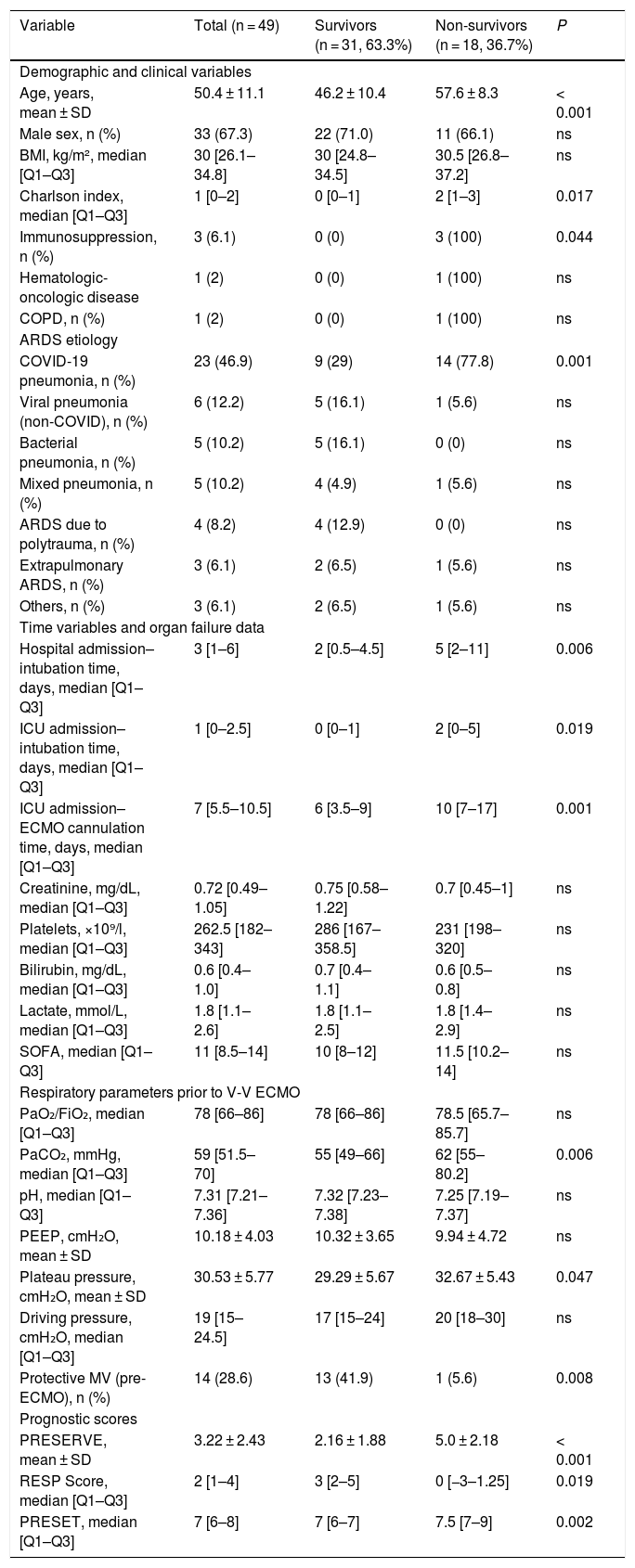
For each patient, the variables shown in Table 1 were recorded. A multivariate analysis was performed using binary logistic regression, including variables associated with mortality in the univariate analysis.
Baseline characteristics, clinical, respiratory, and prognostic variables in patients treated with V-V ECMO.
| Variable | Total (n = 49) | Survivors (n = 31, 63.3%) | Non-survivors (n = 18, 36.7%) | P |
|---|---|---|---|---|
| Demographic and clinical variables | ||||
| Age, years, mean ± SD | 50.4 ± 11.1 | 46.2 ± 10.4 | 57.6 ± 8.3 | < 0.001 |
| Male sex, n (%) | 33 (67.3) | 22 (71.0) | 11 (66.1) | ns |
| BMI, kg/m², median [Q1–Q3] | 30 [26.1–34.8] | 30 [24.8–34.5] | 30.5 [26.8–37.2] | ns |
| Charlson index, median [Q1–Q3] | 1 [0–2] | 0 [0–1] | 2 [1–3] | 0.017 |
| Immunosuppression, n (%) | 3 (6.1) | 0 (0) | 3 (100) | 0.044 |
| Hematologic-oncologic disease | 1 (2) | 0 (0) | 1 (100) | ns |
| COPD, n (%) | 1 (2) | 0 (0) | 1 (100) | ns |
| ARDS etiology | ||||
| COVID-19 pneumonia, n (%) | 23 (46.9) | 9 (29) | 14 (77.8) | 0.001 |
| Viral pneumonia (non-COVID), n (%) | 6 (12.2) | 5 (16.1) | 1 (5.6) | ns |
| Bacterial pneumonia, n (%) | 5 (10.2) | 5 (16.1) | 0 (0) | ns |
| Mixed pneumonia, n (%) | 5 (10.2) | 4 (4.9) | 1 (5.6) | ns |
| ARDS due to polytrauma, n (%) | 4 (8.2) | 4 (12.9) | 0 (0) | ns |
| Extrapulmonary ARDS, n (%) | 3 (6.1) | 2 (6.5) | 1 (5.6) | ns |
| Others, n (%) | 3 (6.1) | 2 (6.5) | 1 (5.6) | ns |
| Time variables and organ failure data | ||||
| Hospital admission–intubation time, days, median [Q1–Q3] | 3 [1–6] | 2 [0.5–4.5] | 5 [2–11] | 0.006 |
| ICU admission–intubation time, days, median [Q1–Q3] | 1 [0–2.5] | 0 [0–1] | 2 [0–5] | 0.019 |
| ICU admission–ECMO cannulation time, days, median [Q1–Q3] | 7 [5.5–10.5] | 6 [3.5–9] | 10 [7–17] | 0.001 |
| Creatinine, mg/dL, median [Q1–Q3] | 0.72 [0.49–1.05] | 0.75 [0.58–1.22] | 0.7 [0.45–1] | ns |
| Platelets, ×10⁹/l, median [Q1–Q3] | 262.5 [182–343] | 286 [167–358.5] | 231 [198–320] | ns |
| Bilirubin, mg/dL, median [Q1–Q3] | 0.6 [0.4–1.0] | 0.7 [0.4–1.1] | 0.6 [0.5–0.8] | ns |
| Lactate, mmol/L, median [Q1–Q3] | 1.8 [1.1–2.6] | 1.8 [1.1–2.5] | 1.8 [1.4–2.9] | ns |
| SOFA, median [Q1–Q3] | 11 [8.5–14] | 10 [8–12] | 11.5 [10.2–14] | ns |
| Respiratory parameters prior to V-V ECMO | ||||
| PaO₂/FiO₂, median [Q1–Q3] | 78 [66–86] | 78 [66–86] | 78.5 [65.7–85.7] | ns |
| PaCO₂, mmHg, median [Q1–Q3] | 59 [51.5–70] | 55 [49–66] | 62 [55–80.2] | 0.006 |
| pH, median [Q1–Q3] | 7.31 [7.21–7.36] | 7.32 [7.23–7.38] | 7.25 [7.19–7.37] | ns |
| PEEP, cmH₂O, mean ± SD | 10.18 ± 4.03 | 10.32 ± 3.65 | 9.94 ± 4.72 | ns |
| Plateau pressure, cmH₂O, mean ± SD | 30.53 ± 5.77 | 29.29 ± 5.67 | 32.67 ± 5.43 | 0.047 |
| Driving pressure, cmH₂O, median [Q1–Q3] | 19 [15–24.5] | 17 [15–24] | 20 [18–30] | ns |
| Protective MV (pre-ECMO), n (%) | 14 (28.6) | 13 (41.9) | 1 (5.6) | 0.008 |
| Prognostic scores | ||||
| PRESERVE, mean ± SD | 3.22 ± 2.43 | 2.16 ± 1.88 | 5.0 ± 2.18 | < 0.001 |
| RESP Score, median [Q1–Q3] | 2 [1–4] | 3 [2–5] | 0 [−3–1.25] | 0.019 |
| PRESET, median [Q1–Q3] | 7 [6–8] | 7 [6–7] | 7.5 [7–9] | 0.002 |
ECMO: extracorporeal membrane oxygenation; BMI: body mass index; ns: not significant; HFOT: high-flow oxygen therapy; PEEP: positive end-expiratory pressure; SOFA: Sequential Organ Failure Assessment; MV: mechanical ventilation; NIMV: noninvasive mechanical ventilation.
The HUMS ECMO Group evaluated a total of 97 patients. V-V ECMO treatment was ruled out in 45 patients for not meeting respiratory criteria or due to contraindications and/or comorbidities. A total of 52 patients were treated with V-V ECMO, all in the HUMS ICU. Of these, 3 were excluded because the device was implanted as a bridge to lung transplantation. Of the 49 patients treated with V-V ECMO as a bridge to recovery, 15 were cannulated in their referring hospital and transferred to HUMS connected to V-V ECMO (MES). Finally, 49 patients were included in the study, with a 1-year survival of 63.3% (Table 1).
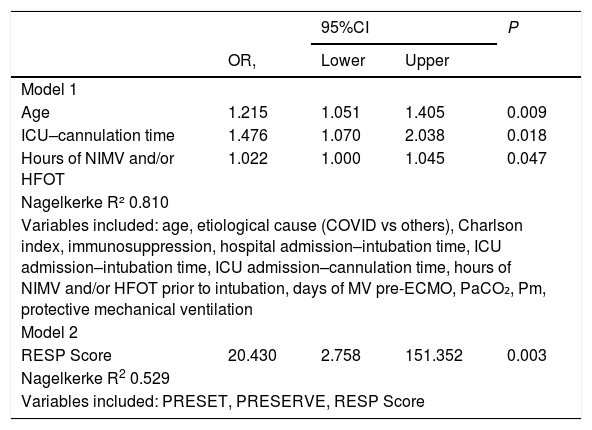
Model 1 of the binary logistic regression analysis showed an independent statistical association with age, the length of the ICU stay prior to cannulation, and time on noninvasive mechanical ventilation (NIMV) or high-flow oxygen therapy (HFOT) before intubation (Table 2). Regarding prognostic scoring systems, only the RESP score showed an independent positive statistical association as a predictor of 1-year mortality (model 2, Table 2).
Binary logistic regression models. Dependent variable: all-cause mortality at one year after ICU admission.
| 95%CI | P | |||
|---|---|---|---|---|
| OR, | Lower | Upper | ||
| Model 1 | ||||
| Age | 1.215 | 1.051 | 1.405 | 0.009 |
| ICU–cannulation time | 1.476 | 1.070 | 2.038 | 0.018 |
| Hours of NIMV and/or HFOT | 1.022 | 1.000 | 1.045 | 0.047 |
| Nagelkerke R² 0.810 | ||||
| Variables included: age, etiological cause (COVID vs others), Charlson index, immunosuppression, hospital admission–intubation time, ICU admission–intubation time, ICU admission–cannulation time, hours of NIMV and/or HFOT prior to intubation, days of MV pre-ECMO, PaCO₂, Pm, protective mechanical ventilation | ||||
| Model 2 | ||||
| RESP Score | 20.430 | 2.758 | 151.352 | 0.003 |
| Nagelkerke R2 0.529 | ||||
| Variables included: PRESET, PRESERVE, RESP Score | ||||
The results from our low-volume center are consistent with those reported in the literature and by higher-volume centers,7,8 demonstrating an independent association between increased 1-year mortality and older age7 as well as longer delay in therapy initiation.8 The duration of MV prior to initiation of V-V ECMO has been described as a prognostic factor.8 However, our data show that these durations are longer than those reported by other authors,3,8 without demonstrating an independent association with mortality. This result may be related to the standardization of pre-implant MV use and the early initiation of V-V ECMO therapy when protective parameters cannot be maintained (Pm <30 cmH2O, DP < 15 cmH2O, and FiO2 <90%) to meet established gasometric criteria, thereby minimizing the risk of pre-ECMO VILI. This protocol could be extrapolated to other centers without ECMO programs by standardizing ventilatory management through the application of protective MV parameters using Pm and DP calculations. Therefore, patients with an indication for V-V ECMO would be identified early, reducing the risk of VILI, facilitating information exchange with ECMO centers, and shortening response times.
The influence of prolonged durations of HFOT and/or NIMV showed an independent association with increased mortality. This finding would support the hypothesis of possible additional lung injury related to respiratory effort, or patient self-inflicted lung injury (P-SILI), described in the literature as a poor prognostic factor.9 This phenomenon, facilitated by HFOT and/or NIMV, may have been exacerbated in the subgroup of COVID-19 patients due to “happy hypoxemia”,10 in which there is a discrepancy between the patient’s respiratory comfort and the degree of hypoxemia. However, P-SILI was not objectively identified.
Homogenization of study groups and standardization in the management of patients undergoing ECMO therapy, from indication to management, are the foundation for improving survival outcomes. P-SILI should be detected early through close monitoring of patients receiving HFOT and/or NIMV. In addition, by avoiding the incidence rate of pre-ECMO VILI through protective MV, longer durations of MV could be allowed without impacting survival, indicating initiation of V-V ECMO therapy when protective MV is no longer maintained. Finally, mortality predicted by the three scores was higher than that observed. The RESP score may complement clinical judgment in decision-making.6
Author’s contributionsAll authors confirm their participation in the preparation of this work.
Declaration of Generative AI and AI-assisted technologies in the writing processThe authors declare that no artificial intelligence (AI) tools were used.
FundingNone declared.
None declared.
The following are Supplementary data to this article: