
Edited by: Juan Antonio Llompart-Pou - Specialist in Intensive Care Medicine, Doctorate in Health Sciences, Universitat Illes Balears. Department of Intensive Care Medicine, Trauma and Neurocritical ICU, Hospital Universitari Son Espases. Palma, Spain
Last update: April 2026
More infoSpontaneous subarachnoid hemorrhage (SAH) represents a therapeutic challenge in intensive care units (ICUs), not only because of its clinical complexity but also due to the need for a comprehensive approach to its various complications. Among these complications, hyperthermia is frequent; therefore, strict temperature control should be considered one of the fundamental pillars of management.1 Hyperthermia is considered harmful in patients with intracranial hemorrhage because it increases cerebral oxygen and glucose demand and stimulates the release of proinflammatory cytokines that contribute to disruption of the blood–brain barrier, resulting in increased cerebral edema. All of this promotes neuronal injury and increases the risk of secondary damage, which is associated with worse functional outcomes and higher mortality.2
The main groups of SAH patients at risk for temperature disturbances are those with poor neurological status on admission (World Federation of Neurosurgical Societies scale IV and V3), intraventricular hemorrhage, greater volume of subarachnoid hemorrhage, or advanced age.4,5
In 2023, consensus recommendations on temperature management (Targeted Temperature Management [TTM]) in patients with SAH were published.6 Following these recommendations, we hypothesized that variability exists in temperature management across our units. With the aim of exploring current clinical practice in this field, within the REMOS study we conducted a survey on temperature management in patients with SAH.
Investigators participating in the REMOS study, which includes 130 ICU professionals from different Spanish hospitals, were invited to participate via email. Approval from a Clinical Research Ethics Committee was not requested due to the voluntary and anonymous nature of the survey. The survey was open from September 2024 to January 2025 and is available as supplementary material (Supplementary data 1).
In the present study, we analyze the data obtained from the survey. A descriptive statistical analysis was performed using number (percentage) or mean ± standard deviation. The response rate was calculated based on the number of investigators in the REMOS study.
A total of 55 responses were collected, corresponding to a response rate of 42.3%, from 34 centers, most of which provided one or two responses (Supplementary data 2). Patients with SAH were admitted to medical–surgical ICUs in 70.6% of cases, but also to specialized neurocritical units such as neurotrauma (23.5%) and neurosurgical ICUs (5.9%). The mean number of beds in these units was 30 ± 12.
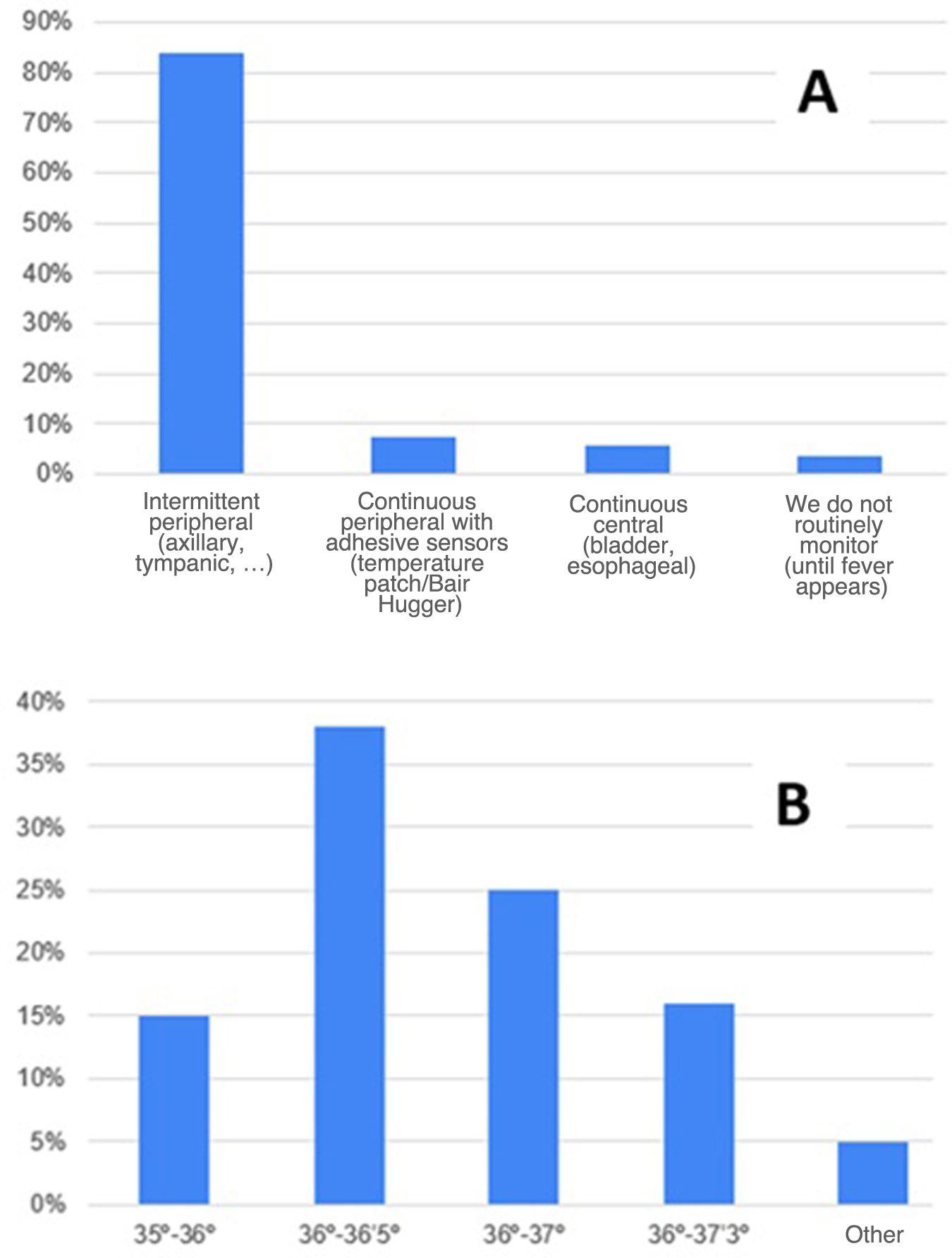
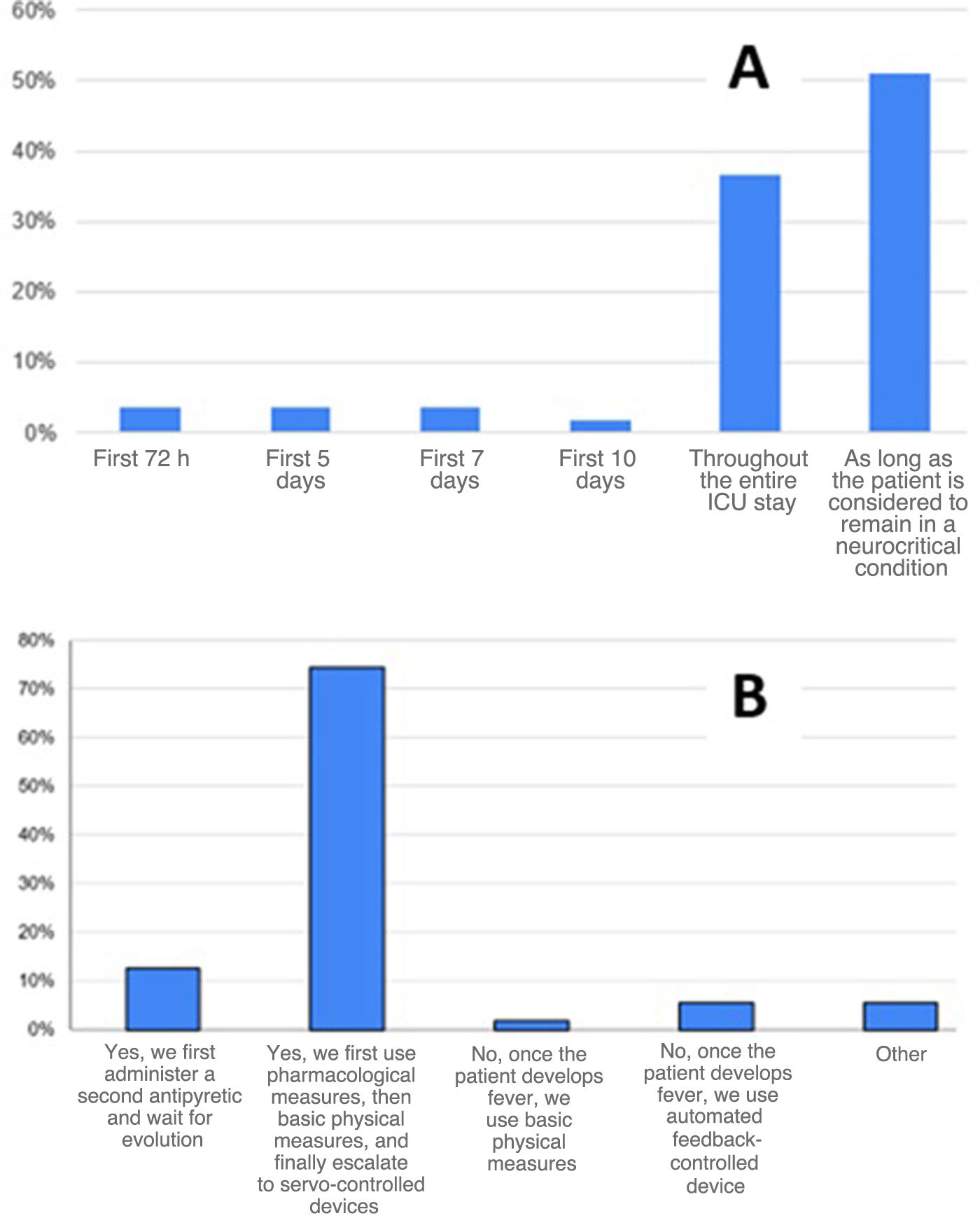
The results demonstrate notable variability in diagnostic criteria for fever, even within the same center. While 47.3% defined fever as > 37.9 °C, the remainder used thresholds ranging from > 37.3 °C to > 38 °C. For temperature monitoring, intermittent peripheral measurement was preferred (84%), although continuous methods were also used (11%), and in some cases temperature was not monitored (3.6%) (Fig. 1A). Moreover, differences were observed in therapeutic target temperatures, with most respondents aiming for ranges between 36 °C and 36.5 °C (Fig. 1B). Regarding the duration of strict temperature control, a large majority maintained it throughout the ICU stay or while the brain remains at risk of secundary injury (87%); however, in some centers control was maintained for fewer days (even only for 72 h) (Fig. 2A). The availability and use of protocols were limited: only 16% had a protocol for fever diagnosis and 14% for the treatment of central fever. Although 64% of respondents systematically prescribed antipyretics, the use of advanced physical measures and automated feedback-controlled devices was not uniform, and their availability was limited in many ICUs due to economic constraints or lack of institutional interest, according to respondents.


A stepwise approach to temperature control predominated (75%) (Fig. 2B), reserving automated feedback-controlled devices as the last therapeutic step, with surface devices (67%) being preferred over intravascular devices (13%). A total of 12.7% maintained device control throughout the entire ICU stay, but most applied it during the initial phases (<7 days). Although these devices were considered fairly safe (43.6%), a considerable proportion (34.5%) believed that they may sometimes interfere with neurological assessment, since neuromuscular blocking agents may be required.
There is a widespread perception that poor fever control may contribute to neurological and extracranial complications (96%). However, only 4% of units had specific indicators to monitor the clinical impact of central fever.
Recent studies suggest that avoiding extreme temperatures (<36 or >39 °C) is associated with better functional outcomes and that persistent fever (>38 °C) increases the risk of unfavorable outcomes.7,8 In patients with poor-grade SAH, implementation of TTM may reduce the rate of severe complications such as vasospasm and delayed cerebral ischemia, and improve functional prognosis.9,10 These data highlight the need to standardize temperature control in the early phase. There is no doubt that well-designed multicenter studies are still needed to confirm these findings, reduce therapeutic heterogeneity, and optimize outcomes in this population. Rigorous temperature control aimed at actively maintaining strict normothermia could have a significant clinical impact by reducing mortality and improving neurological outcomes.
This survey shows considerable variability in the diagnosis and management of temperature, with participation from multiple units across our country. However, we must not overlook the inherent limitations of this type of study, such as selection bias and the lack of prior questionnaire validation. These data should serve as a basis for future research.
CRediT authorship contribution statementABO and LGB designed the study; LGB and MBN performed the analysis and interpretation of the results; MBN drafted the 1st version the manuscript; and LGB and ABO revised the text. All 3 authors approved the final version.
Declaration of Generative AI and AI-assisted technologies in the writing processThe authors did not use any AI tools in the preparation of this work.
FundingNone declared.
None declared.
The authors thank all centers that participated by completing the survey.
The following are Supplementary data to this article: