
Refractory septic shock is a critical condition within the spectrum of sepsis, characterized by an inadequate response to standard hemodynamic resuscitation. In the absence of a consensus operational definition, a consensus study was conducted using the Delphi methodology. Thirty experts in sepsis and hemodynamics participated. Statements related to the definition, diagnostic criteria, and therapy strategies for RSS were evaluated. Consensus was reached on 23 of 28 statements, allowing RSS to be defined as a clinical entity characterized by persistent hypotension and signs of global hypoperfusion for more than one hour, despite optimized initial treatment. Consensus was reached on the use of hydrocortisone, the inclusion of elevated lactate as a marker of hypoperfusion, the utility of advanced hemodynamic monitoring and echocardiography, and general recommendations on the use of combined vasopressors were evaluated. This study lays the groundwork for future research and clinical algorithms.
El shock séptico refractario (SSR) es una afección crítica dentro del espectro de la sepsis, caracterizada por una respuesta insuficiente a la reanimación hemodinámica estándar. Ante la falta de una definición operativa consensuada, se realizó un estudio de consenso utilizando metodología Delphi. Participaron 30 expertos en sepsis y hemodinámica. Se evaluaron afirmaciones relacionadas con definición, criterios diagnósticos y estrategias de tratamiento del SSR. Se alcanzó consenso en 23 de 28 afirmaciones, permitiendo definir el SSR como una entidad clínica caracterizada por hipotensión persistente y signos de hipoperfusión durante más de una hora, a pesar de un tratamiento inicial optimizado. Se consensuó el uso de hidrocortisona, la inclusión de lactato elevado como marcador de hipoperfusión, la utilidad de la monitorización hemodinámica avanzada y la ecocardiografía y se valoraron recomendaciones generales sobre el uso de vasopresores combinados. Este estudio sienta las bases para futuras investigaciones y algoritmos clínicos.
Septic shock represents a critical phase within the continuum of sepsis, associated with high mortality.1 It is defined as a state of sepsis in which profound circulatory and metabolic abnormalities persist, clinically evidenced by the need to initiate early vasopressor support to maintain a mean arterial pressure (MAP) ≥ 65 mmHg after adequate fluid resuscitation, and a serum lactate level > 2 mmol/L (18 mg/dL) in the absence of hypovolemia.2 Its incidence rate is increasing worldwide and affects approximately 30%–44% of patients with sepsis (prevalence of 3/10,000–5/10,000), with an estimated in-hospital mortality ≥ 40%2 and an estimated mortality of 47%–63% in cases with ≥2 organ dysfunctions.3,4
Within this clinical spectrum, refractory septic shock (RSS) represents a critical condition characterized by an inadequate response to standard hemodynamic resuscitation measures. However, there is no universally accepted operational definition that allows homogeneous identification of these patients in clinical practice or clinical trials.5,6
In the literature, terms are used interchangeably to describe these presentations of septic shock, such as “refractory septic shock” (RSS) or “catecholamine resistance,” which are applied regardless of the dose and type of vasopressor administered to the patient or even the combination of ≥ 2 vasoactive agents. However, it is essential to define the concepts and diagnostic criteria for both RSS and catecholamine resistance.7
The absence of a clear definition makes it difficult to compare studies, standardize criteria for patient inclusion in clinical trials, and generates heterogeneity in clinical practice, among other issues. Moreover, it may lead to delayed or inadequate interventions, reducing the effectiveness of therapeutic strategies. Early identification of RSS would allow for more targeted intervention, including the rational use of alternative vasopressors, adjunctive therapies, and/or hemodynamic support devices.8–10
The aim of this work is to develop a consensus document intended to identify key aspects related to the definition, diagnosis, and management of RSS. This standardization seeks to promote more precise patient identification to improve the epidemiological understanding of the disease, optimize case selection in clinical trials, and facilitate the development and implementation of new therapeutic strategies.
MethodologyStudy designThe study was conducted using an adapted two-round Delphi methodology, with the aim of reaching consensus on the standardization of key aspects regarding the definition, diagnosis, and management of RSS.
The Delphi method is a social research tool whose purpose is to achieve a reliable collective opinion from a group of experts.11 Participants must be consulted at least twice on the same topic, allowing them to revise their responses after learning the opinions of the other panelists. Anonymity of responses is guaranteed, and there is no temporal or in-person interaction among participants. Communication of information is channeled through the study’s scientific committee, which determines the data shared with the panelists.11
An advisory scientific committee including 5 experts (4 specialists in intensive care medicine and 1 specialist in anesthesiology and resuscitation), active members of their respective scientific societies, with extensive clinical, teaching, and research experience in the field of sepsis and hemodynamics (with an H-index > 20 in these fields), was responsible for designing and validating the content of the Delphi questionnaire, validating the aggregated analysis results, and drafting and validating the final document.
The expert panel consisted of 30 specialists with expertise in sepsis and hemodynamics.
The preparation and writing of this manuscript followed the EQUATOR Network guidelines with the recommendations of the RIGHT-Statement (Reporting Items for Practice Guidelines in Healthcare) and the Appraisal of Guidelines for Research & Evaluation (AGREE-II) tool (Tables 1 and 2 of the supplementary data).
Study questionnaireThe questionnaire was designed based on a targeted literature search conducted across the Medline and PubMed databases (https://pubmed.ncbi.nlm.nih.gov/), to identify relevant aspects of the study. MeSH and automatic filters were applied to limit the results to publications from the last 10 years, studies in humans and adults (over 19 years of age) to obtain an updated and relevant overview of the available literature (Table 3 of the supplementary data). Based on this information, a questionnaire with 28 statements was developed. For those items where no consensus was reached, the statements were redefined, and 5 questions were removed due to lack of scientific evidence for the 2nd round, although they had been included in the 1st one to assess the clinical perception of the experts. The questionnaire was validated through a semantic review to ensure terminological consistency, as well as an evaluation of the relevance of each item.
Each statement had to be rated according to the level of agreement using the following options: “Strongly agree,” “Agree,” “Slightly agree,” and “Disagree.” The statements were organized into 3 sections: block #1: Definition of RSS (7 statements); block #2: Diagnostic criteria for RSS (7 statements); and block #3: Therapeutic strategy for RSS (14 statements). Due to technical issues, the results of question 12 in block #3 were not obtained. The questionnaire was programmed using the Google® Forms tool (https://docs.google.com/forms/u/0/).
Selection of the expert panelThe expert panel consisted of 30 professionals involved in the management of RSS in Spain, including 20 intensivists and 10 anesthesiologists. The Delphi study was double-blind for the panelists. In the Delphi context, “double-blind” indicates that panelists are unaware of the identity and individual responses of the other participants, ensuring anonymity among them. The coordinating team knows the identity of the panelists only for logistical management purposes, without influencing their responses or individual analysis.
Panelists were selected by the advisory scientific committee. For their selection, rigorous criteria were considered, such as their professional trajectory, the relevance and volume of their scientific publications, their participation in research projects, and their affiliation with highly prestigious hospitals (Table 4 and Fig. 1 of the supplementary data).
An invitation describing the objective of the study and the Delphi process was sent. After agreeing to participate, the experts received a link to access the Delphi questionnaire, with the option to withdraw at any time.
Delphi questionnaire roundsThe 1st round took place on December 10th, 2024, with responses collected from December 12 through January 8, and the 2nd round on February 26th, 2025, from March 3 through March 10th. The questionnaire was completed virtually and anonymously.
After analyzing the data obtained in the 1st round, items that had reached consensus were removed. For the 2nd round, the updated Delphi questionnaire was sent to all respondents, along with a summary of the 1st-round results, allowing them to modify their responses based on the general judgment expressed by the expert panel.
The advisory committee reviewed the results of both the 1st and 2nd rounds after their completion (Fig. 2, supplementary data).
Data analysisConsensus was considered achieved when at least 75% of the panelists provided the same response. In the absence of an absolute majority for a single category, it was agreed to group responses into “Strongly agree” and “Agree” on one hand, and “Slightly agree” and “Disagree” on the other.
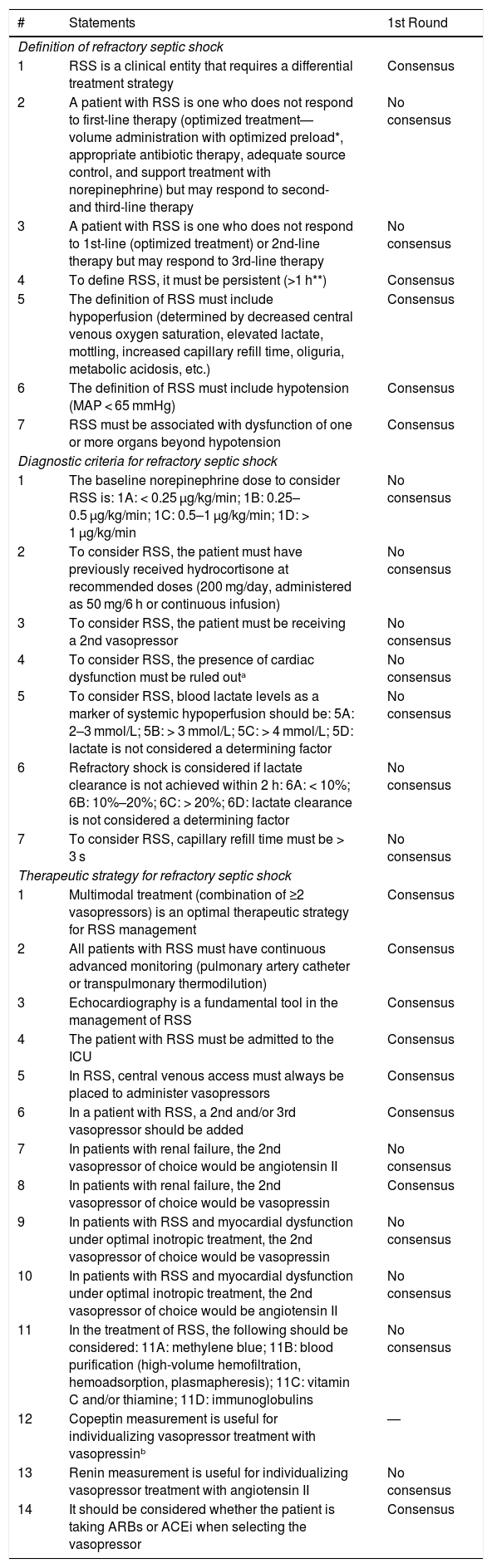
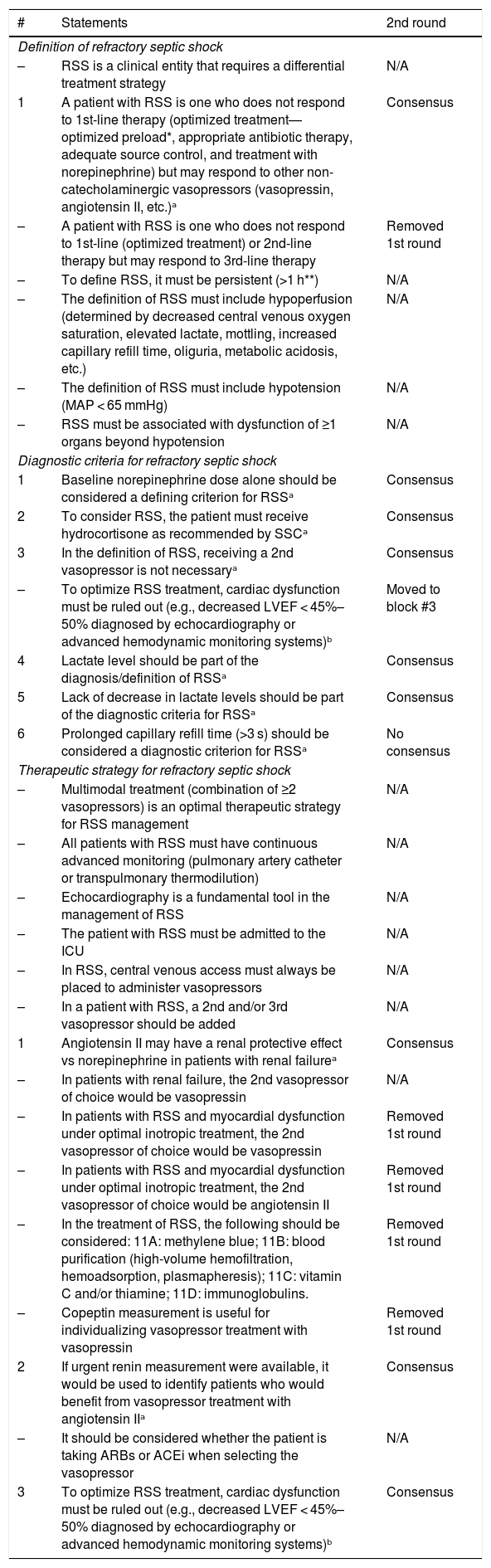
ResultsThe response rate obtained from the 30 specialists was 100% in both rounds of the Delphi study. Table 1 illustrates the statements from the first questionnaire, as well as the consensus results from the 1st round, and Table 2 presents the statements from the 2nd questionnaire, along with the results from the 2nd round.
Consensus results of the statements obtained by the panelists in the first round.
| # | Statements | 1st Round |
|---|---|---|
| Definition of refractory septic shock | ||
| 1 | RSS is a clinical entity that requires a differential treatment strategy | Consensus |
| 2 | A patient with RSS is one who does not respond to first-line therapy (optimized treatment—volume administration with optimized preload*, appropriate antibiotic therapy, adequate source control, and support treatment with norepinephrine) but may respond to second- and third-line therapy | No consensus |
| 3 | A patient with RSS is one who does not respond to 1st-line (optimized treatment) or 2nd-line therapy but may respond to 3rd-line therapy | No consensus |
| 4 | To define RSS, it must be persistent (>1 h**) | Consensus |
| 5 | The definition of RSS must include hypoperfusion (determined by decreased central venous oxygen saturation, elevated lactate, mottling, increased capillary refill time, oliguria, metabolic acidosis, etc.) | Consensus |
| 6 | The definition of RSS must include hypotension (MAP < 65 mmHg) | Consensus |
| 7 | RSS must be associated with dysfunction of one or more organs beyond hypotension | Consensus |
| Diagnostic criteria for refractory septic shock | ||
| 1 | The baseline norepinephrine dose to consider RSS is: 1A: < 0.25 μg/kg/min; 1B: 0.25–0.5 μg/kg/min; 1C: 0.5–1 μg/kg/min; 1D: > 1 μg/kg/min | No consensus |
| 2 | To consider RSS, the patient must have previously received hydrocortisone at recommended doses (200 mg/day, administered as 50 mg/6 h or continuous infusion) | No consensus |
| 3 | To consider RSS, the patient must be receiving a 2nd vasopressor | No consensus |
| 4 | To consider RSS, the presence of cardiac dysfunction must be ruled outᵃ | No consensus |
| 5 | To consider RSS, blood lactate levels as a marker of systemic hypoperfusion should be: 5A: 2–3 mmol/L; 5B: > 3 mmol/L; 5C: > 4 mmol/L; 5D: lactate is not considered a determining factor | No consensus |
| 6 | Refractory shock is considered if lactate clearance is not achieved within 2 h: 6A: < 10%; 6B: 10%–20%; 6C: > 20%; 6D: lactate clearance is not considered a determining factor | No consensus |
| 7 | To consider RSS, capillary refill time must be > 3 s | No consensus |
| Therapeutic strategy for refractory septic shock | ||
| 1 | Multimodal treatment (combination of ≥2 vasopressors) is an optimal therapeutic strategy for RSS management | Consensus |
| 2 | All patients with RSS must have continuous advanced monitoring (pulmonary artery catheter or transpulmonary thermodilution) | Consensus |
| 3 | Echocardiography is a fundamental tool in the management of RSS | Consensus |
| 4 | The patient with RSS must be admitted to the ICU | Consensus |
| 5 | In RSS, central venous access must always be placed to administer vasopressors | Consensus |
| 6 | In a patient with RSS, a 2nd and/or 3rd vasopressor should be added | Consensus |
| 7 | In patients with renal failure, the 2nd vasopressor of choice would be angiotensin II | No consensus |
| 8 | In patients with renal failure, the 2nd vasopressor of choice would be vasopressin | Consensus |
| 9 | In patients with RSS and myocardial dysfunction under optimal inotropic treatment, the 2nd vasopressor of choice would be vasopressin | No consensus |
| 10 | In patients with RSS and myocardial dysfunction under optimal inotropic treatment, the 2nd vasopressor of choice would be angiotensin II | No consensus |
| 11 | In the treatment of RSS, the following should be considered: 11A: methylene blue; 11B: blood purification (high-volume hemofiltration, hemoadsorption, plasmapheresis); 11C: vitamin C and/or thiamine; 11D: immunoglobulins | No consensus |
| 12 | Copeptin measurement is useful for individualizing vasopressor treatment with vasopressinᵇ | — |
| 13 | Renin measurement is useful for individualizing vasopressor treatment with angiotensin II | No consensus |
| 14 | It should be considered whether the patient is taking ARBs or ACEi when selecting the vasopressor | Consensus |
ARBs: angiotensin II receptor blockers; ACEi: angiotensin-converting enzyme inhibitors; MAP: mean arterial pressure; RSS: refractory septic shock; ICU: intensive care unit.
Consensus results of the statements obtained by the panelists in the 2nd round.
| # | Statements | 2nd round |
|---|---|---|
| Definition of refractory septic shock | ||
| – | RSS is a clinical entity that requires a differential treatment strategy | N/A |
| 1 | A patient with RSS is one who does not respond to 1st-line therapy (optimized treatment—optimized preload*, appropriate antibiotic therapy, adequate source control, and treatment with norepinephrine) but may respond to other non-catecholaminergic vasopressors (vasopressin, angiotensin II, etc.)ᵃ | Consensus |
| – | A patient with RSS is one who does not respond to 1st-line (optimized treatment) or 2nd-line therapy but may respond to 3rd-line therapy | Removed 1st round |
| – | To define RSS, it must be persistent (>1 h**) | N/A |
| – | The definition of RSS must include hypoperfusion (determined by decreased central venous oxygen saturation, elevated lactate, mottling, increased capillary refill time, oliguria, metabolic acidosis, etc.) | N/A |
| – | The definition of RSS must include hypotension (MAP < 65 mmHg) | N/A |
| – | RSS must be associated with dysfunction of ≥1 organs beyond hypotension | N/A |
| Diagnostic criteria for refractory septic shock | ||
| 1 | Baseline norepinephrine dose alone should be considered a defining criterion for RSSᵃ | Consensus |
| 2 | To consider RSS, the patient must receive hydrocortisone as recommended by SSCᵃ | Consensus |
| 3 | In the definition of RSS, receiving a 2nd vasopressor is not necessaryᵃ | Consensus |
| – | To optimize RSS treatment, cardiac dysfunction must be ruled out (e.g., decreased LVEF < 45%–50% diagnosed by echocardiography or advanced hemodynamic monitoring systems)ᵇ | Moved to block #3 |
| 4 | Lactate level should be part of the diagnosis/definition of RSSᵃ | Consensus |
| 5 | Lack of decrease in lactate levels should be part of the diagnostic criteria for RSSᵃ | Consensus |
| 6 | Prolonged capillary refill time (>3 s) should be considered a diagnostic criterion for RSSᵃ | No consensus |
| Therapeutic strategy for refractory septic shock | ||
| – | Multimodal treatment (combination of ≥2 vasopressors) is an optimal therapeutic strategy for RSS management | N/A |
| – | All patients with RSS must have continuous advanced monitoring (pulmonary artery catheter or transpulmonary thermodilution) | N/A |
| – | Echocardiography is a fundamental tool in the management of RSS | N/A |
| – | The patient with RSS must be admitted to the ICU | N/A |
| – | In RSS, central venous access must always be placed to administer vasopressors | N/A |
| – | In a patient with RSS, a 2nd and/or 3rd vasopressor should be added | N/A |
| 1 | Angiotensin II may have a renal protective effect vs norepinephrine in patients with renal failureᵃ | Consensus |
| – | In patients with renal failure, the 2nd vasopressor of choice would be vasopressin | N/A |
| – | In patients with RSS and myocardial dysfunction under optimal inotropic treatment, the 2nd vasopressor of choice would be vasopressin | Removed 1st round |
| – | In patients with RSS and myocardial dysfunction under optimal inotropic treatment, the 2nd vasopressor of choice would be angiotensin II | Removed 1st round |
| – | In the treatment of RSS, the following should be considered: 11A: methylene blue; 11B: blood purification (high-volume hemofiltration, hemoadsorption, plasmapheresis); 11C: vitamin C and/or thiamine; 11D: immunoglobulins. | Removed 1st round |
| – | Copeptin measurement is useful for individualizing vasopressor treatment with vasopressin | Removed 1st round |
| 2 | If urgent renin measurement were available, it would be used to identify patients who would benefit from vasopressor treatment with angiotensin IIᵃ | Consensus |
| – | It should be considered whether the patient is taking ARBs or ACEi when selecting the vasopressor | N/A |
| 3 | To optimize RSS treatment, cardiac dysfunction must be ruled out (e.g., decreased LVEF < 45%–50% diagnosed by echocardiography or advanced hemodynamic monitoring systems)ᵇ | Consensus |
The consensus reached in each statement corresponds to a response rate ≥ 75% of experts answering “agree” or “strongly agree.”.
ARBs: angiotensin II receptor blockers; LVEF: left ventricular ejection fraction; ACE inhibitors: angiotensin-converting enzyme inhibitors; N/A: not applicable; MAP: mean arterial pressure; SSC: Surviving Sepsis Campaign; RSS: refractory septic shock; ICU: intensive care unit.
In the 1st round (Table 1), agreement was reached for 13 out of the 28 statements initially included (46.4%). The statements that reached consensus were not included in the 2nd round. Of the statements without consensus, 5 were eliminated and the remaining 10 were reformulated. In the 2nd round (Table 2), agreement was reached for 9 out of 10 statements (90%). Overall, after the 2 rounds, agreement was reached for 22 statements (95.6%).
Definition of refractory septic shockIn the 1st round, consensus was reached for 5 out of 7 statements. The experts agreed that RSS is a clinical entity requiring a differential treatment strategy (100% of experts), as well as on the need to consider persistence of the condition (76.7%), together with the presence of hypoperfusion (96.6%), hypotension (80%), and failure of ≥1 organs (80%) within the definition of the profile of a patient with RSS.
No consensus was reached regarding whether a patient with RSS is one who does not respond to 1st-line therapy but may respond to 2nd- and 3rd-line therapy (66.6%), or one who does not respond to 1st- or 2nd-line therapy but may respond to 3rd-line therapy (63.4%).
The statement regarding lack of response to 1st- and 2nd-line therapy but possible response to 3rd-line therapy was eliminated, as such a level of refractoriness was considered unnecessary. The statement regarding whether a patient who does not respond to 1st-line therapy may respond to 2nd- and 3rd-line therapy was reformulated and included in the 2nd round (A patient with RSS is one who does not respond to 1st-line therapy (optimized treatment: adequate preload, appropriate antibiotic therapy, source control, and treatment with norepinephrine), but may respond to other non-catecholaminergic vasopressors (vasopressin, angiotensin II, etc.)), reaching consensus with 93.3% of experts.
Table 5 and Fig. 3 of the supplementary data show the level of agreement for each statement in block 1 according to the round.
Diagnostic criteria for refractory septic shockRegarding the 7 statements included in block 2, no consensus was reached for any of them after the 1st round.
All statements were reformulated and included in the 2nd round. Additionally, the statement regarding ruling out cardiac dysfunction to optimize RSS treatment through echocardiography or advanced hemodynamic monitoring was moved to block #3, as it referred to treatment.
In the following round, consensus was reached regarding the need to receive hydrocortisone to be considered RSS (80% of experts), as well as considering baseline norepinephrine dose as a defining criterion (90%), that receiving a 2nd vasopressor is not necessary (86.7%), as well as considering lactate level for the diagnosis of RSS (80%), and the absence of a decrease in lactate levels as part of the diagnostic criteria (80%).
No consensus was ever reached regarding whether prolonged capillary refill time (>3 s) should be considered a diagnostic criterion for RSS (46.4% of experts).
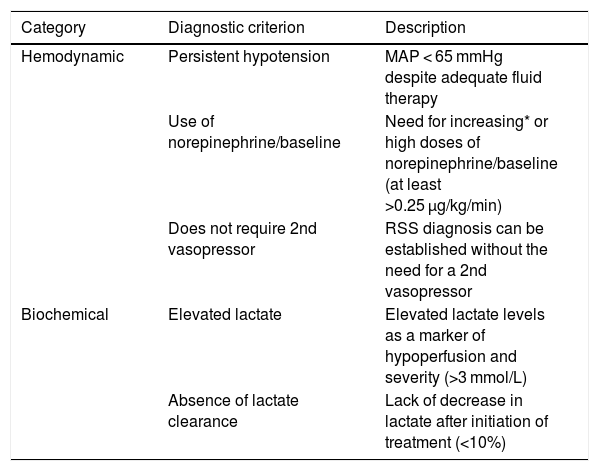
Table 6 and Fig. 4 of the supplementary data show the level of agreement for each statement in block 2 according to the round. Table 3 presents the agreed diagnostic criteria.
Accepted diagnostic criteria for RSS.
| Category | Diagnostic criterion | Description |
|---|---|---|
| Hemodynamic | Persistent hypotension | MAP < 65 mmHg despite adequate fluid therapy |
| Use of norepinephrine/baseline | Need for increasing* or high doses of norepinephrine/baseline (at least >0.25 μg/kg/min) | |
| Does not require 2nd vasopressor | RSS diagnosis can be established without the need for a 2nd vasopressor | |
| Biochemical | Elevated lactate | Elevated lactate levels as a marker of hypoperfusion and severity (>3 mmol/L) |
| Absence of lactate clearance | Lack of decrease in lactate after initiation of treatment (<10%) |
MAP: mean arterial pressure; RSS: refractory septic shock.
“Increasing norepinephrine doses” refers to the process of progressively increasing the infusion rate of norepinephrine to achieve a desired hemodynamic target, typically MAP, in critically ill patients.43,44
Among the statements in block #3, consensus was reached after the 1st round for 8 out of 14 statements. All the experts (100%) agreed that multimodal treatment is an optimal therapeutic strategy for the management of RSS, as well as ICU admission, placement of central venous access for vasopressor administration, and the addition of a 2nd and/or 3rd vasopressor. Moreover, consensus was reached on the need for continuous advanced monitoring (76.6% of experts), echocardiography as a fundamental tool (96.7%), vasopressin as the 2nd vasopressor of choice in patients with renal failure (83.3%), and considering concomitant treatments with angiotensin II receptor blockers (ARBs) or angiotensin-converting enzyme inhibitors (ACE inhibitors) when selecting the vasopressor (90%). Regarding the use of adjunctive therapies, the expert panel reached consensus on not using immunoglobulins routinely in the treatment of RSS (80%).
No consensus was ever reached for the remaining statements. The statements regarding angiotensin II as the treatment of choice in renal failure and renin as a biomarker for angiotensin II treatment were reformulated and included in the 2nd round. The remaining statements were eliminated due to insufficient published scientific evidence to address these questions.
In the 2nd round, 90% of experts agreed on ruling out the presence of cardiac dysfunction to optimize treatment and that angiotensin II could have a renal protective effect vs baseline norepinephrine in patients with renal failure, while 96.7% of experts also considered that, if urgent renin measurement were available, they would use it to identify patients who would benefit from vasopressor treatment with angiotensin II.
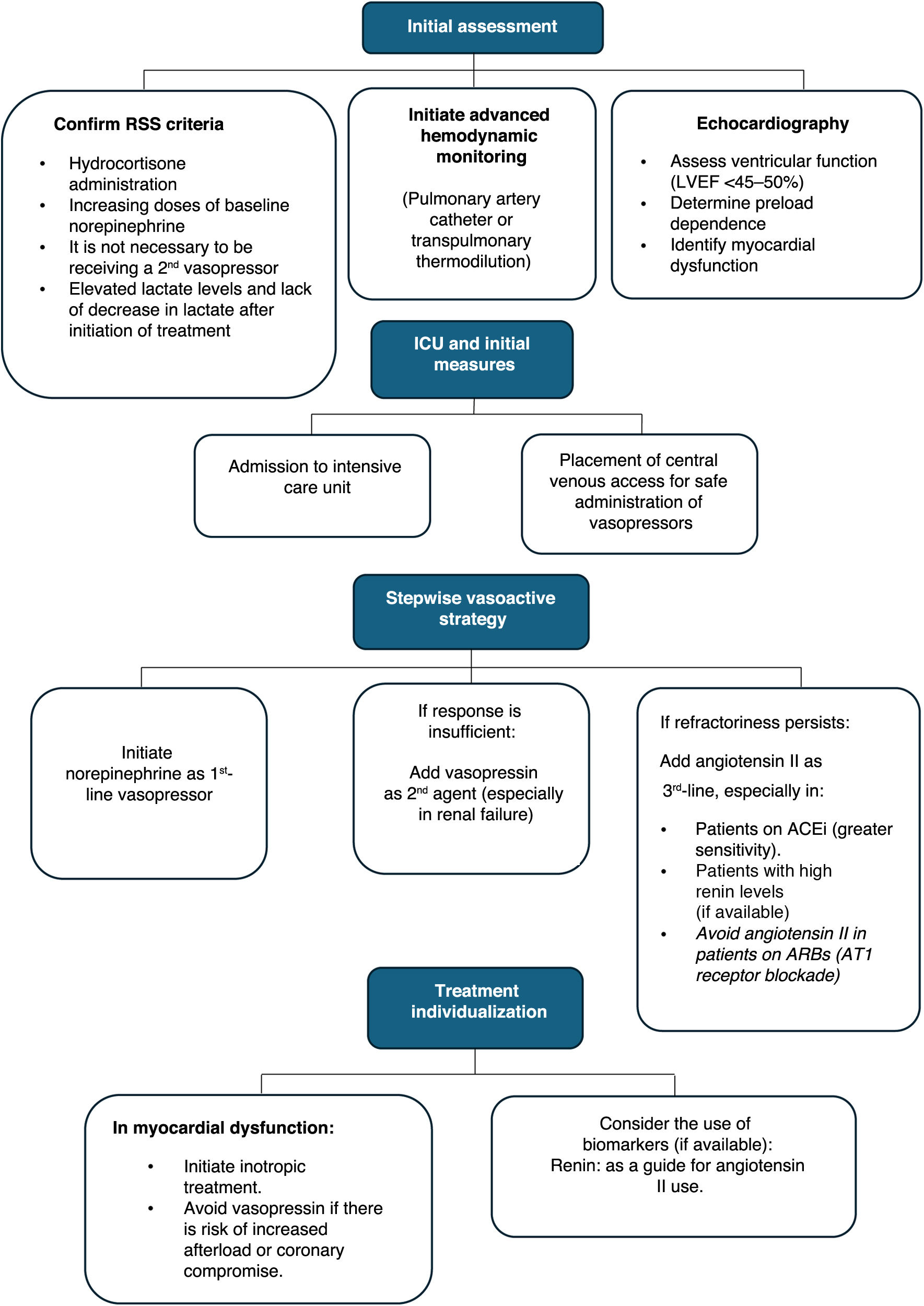
Table 7 and Fig. 5 of the supplementary data show the level of agreement for each statement in block #3 according to the round. Fig. 1 shows the agreed treatment algorithm.
Discussion
This Delphi study represents the first documented effort to achieve expert consensus in critically ill patients to establish an operational definition, diagnostic criteria, and management strategies for RSS, addressing the objective of standardizing key concepts in this entity and reaching agreement on fundamental aspects such as the need for a precise definition, the inclusion of diagnostic parameters such as persistent hypotension, hypoperfusion, the use of hydrocortisone, elevated lactate, and echocardiography, as well as a multimodal therapeutic strategy.
Definition of refractory septic shockAccording to the results, RSS would constitute a distinct clinical entity requiring a specific therapeutic strategy. This reinforces the need to identify non-responder patients who may benefit from personalized therapeutic approaches.12
Consensus was reached that RSS should be persistent (>1 h), which is consistent with the literature emphasizing duration despite adequate resuscitation.14 Although there is no universal threshold, a duration of “>1 h” would be useful for early identification of patients with RSS.
In addition, the definition of RSS should include the presence of hypoperfusion data, such as elevated lactate, oliguria, or metabolic acidosis. This finding is supported by international clinical practice guidelines13,15 and reinforces the inclusion of these markers in its definition.
Organ dysfunction, beyond hypotension, should also be included as a diagnostic criterion, in line with the Sepsis-3 definition,16 which highlights that organ dysfunction, especially cardiovascular, indicates greater severity in defining the refractory nature.17–19 It was agreed to include hypotension ([MAP] < 65 mmHg) in the definition, facilitating the identification of severe patients and the indication for vasopressor therapy.2,16,20
The expert panel reached consensus in considering RSS in patients who do not respond to 1st-line treatment but may respond to other non-catecholaminergic vasopressors (vasopressin, angiotensin II). No consensus was reached on considering other treatment lines beyond vasopressor support as a criterion for RSS, suggesting that experts defined refractoriness based on response to or need for 2nd- or 3rd-line vasopressor support rather than other treatments.13,15,21
Agreement also increased regarding the concept that a patient with RSS may not respond to 1st-line therapy but to 2nd- or 3rd-line therapy. This supports a stepwise therapeutic approach, in which additional interventions such as corticosteroids, alternative vasopressors, vitamin C, or even ECMO are introduced after failure of initial therapy with fluids, antibiotics, or baseline norepinephrine.1,6,15
Following expert consensus, RSS is considered to be present in patients who, after optimized initial management, maintain hypotension and/or signs of global hypoperfusion for more than one hour, requiring the use of one or more vasopressors and advanced monitoring, in a setting of multiorgan failure.
Diagnostic criteriaThe lack of a threshold dose of baseline norepinephrine to define RSS reflects clinical variability and the absence of a universal definition of refractoriness to vasopressor treatment.13,22,23
Although consensus was not reached on a specific norepinephrine dose to define RSS, most of the expert panel rejected considering doses < 0.25 μg/kg/min, suggesting that the threshold dose should be at least above this level. In the 2nd round, consensus was reached to consider baseline norepinephrine dose alone as a criterion to define RSS, recognizing that the need for increasing doses reflects refractoriness to vasopressor support.23
In this regard, there was no consensus on considering the use of a second vasopressor as a mandatory diagnostic criterion to define RSS. Although baseline norepinephrine as 1st -line therapy is widely accepted, guidelines do not specify a 2nd agent to define refractoriness,13 and the decision to add vasopressin or epinephrine depends on the clinical context.24 In the 2nd round, it was agreed that a second vasopressor is not necessary to diagnose RSS, as its absence does not rule out refractoriness if the response to treatment is inadequate.13
Regarding corticosteroid use, experts agreed that all patients with RSS should have received hydrocortisone, unless contraindicated, in full compliance with international clinical practice guidelines. This recommendation is consistent with former studies which, in addition to demonstrating a mortality benefit, have shown reduced vasopressor requirements and faster resolution of shock in patients treated with corticosteroids.25–27
Although elevated lactate levels are associated with worse prognosis and their reduction with better outcomes, it is recommended to evaluate lactate within a dynamic assessment of hemodynamic status,22,23 as it may be elevated due to causes unrelated to hypoperfusion. More than 75% of experts considered that levels > 3 mmol/L could indicate RSS, and the majority rejected considering a clearance < 10% as a diagnostic criterion. After reformulation, consensus was reached to include lactate level and lack of decrease in its levels in the diagnostic definition of RSS, given its usefulness as a marker of hypoperfusion and an indicator of refractoriness.16
Although capillary refill time is a useful and non-invasive tool to assess peripheral perfusion and microcirculatory status, its value as an isolated diagnostic criterion for RSS is limited.13 No consensus was ever breached on considering capillary refill time > 3 s as pathological, due to its sensitivity to external factors and the lack of solid evidence as a single marker of refractoriness, recommending instead a multimodal monitoring approach.28
Therapeutic strategyThe potential impaired response to catecholamines in RSS would support the consensus on multimodal treatment, combining ≥ 2 vasopressors. The sequential addition of vasopressin or angiotensin II would allow optimization of perfusion without increasing the adverse effects of a single agent.6,29 Similarly, the need for continuous advanced hemodynamic monitoring was agreed upon to guide the administration of vasoactive agents, inotropes, and fluid therapy, especially in patients with complex hemodynamic profiles or multiple organ dysfunction.30
Echocardiography was recognized as a key imaging modality to assess cardiovascular status and the dynamic follow-up of ventricular function, preload dependence, and response to treatment, due to its non-invasive nature and availability in intensive care units (ICU).20,31 This perception was reinforced by the need to rule out cardiac dysfunction to optimize RSS treatment, specifying diagnostic criteria such as a left ventricular ejection fraction (LVEF) < 45%–50%, allowing experts to agree on the importance of early identification to adjust individualized treatment.20,32
The need for advanced life support, monitoring, and complex therapies in RSS would justify that all patients should be admitted to the ICU²⁰. In addition, it was agreed that central venous access should be established for the safe administration of vasopressors, avoiding the risk of extravasation and tissue necrosis associated with peripheral administration.33
Finally, consensus was reached on the addition of a 2nd or 3rd vasopressor as part of a stepwise therapeutic strategy.1,6,15 In patients with renal failure, vasopressin is preferred as the 2nd agent due to its favorable hemodynamic profile and lower impact on renal perfusion vs baseline norepinephrine.29,31 The importance of considering chronic treatment with ACEi or ARBs when selecting the vasopressor was recognized. In patients treated with ACEi, angiotensin II is effective by enhancing the hemodynamic response and reducing catecholamine use, whereas in those treated with ARBs, AT1 receptor blockade reduces the effect of exogenous angiotensin II.34,35
No consensus was ever reached on the use of angiotensin II as a 2nd vasopressor in patients with renal failure or myocardial dysfunction under optimal inotropic treatment, likely due to limited evidence and its application restricted to specific contexts,36 nor on vasopressin as a 2nd vasopressor in patients with myocardial dysfunction, due to its potential effects on afterload and coronary perfusion.29,31 After reformulation, consensus was reached on the possible renal protective effect of angiotensin II vs baseline norepinephrine in patients with renal failure,37 as it may improve renal perfusion in subgroups of patients with vasodilatory shock.38
Regarding adjunctive therapies such as methylene blue, blood purification, vitamin C and/or thiamine, and immunoglobulins, the lack of consensus may reflect the absence of robust and consistent evidence supporting their systematic use, as results are heterogeneous and they are considered experimental or compassionate-use therapies.5,20,39
No agreement was ever reached either on the usefulness of copeptin or renin measurement to individualize vasopressor treatment. Although these markers could help identify patient phenotypes potentially responsive to treatment—low copeptin levels may predict better response to vasopressin, and high renin levels to angiotensin II—their clinical use is limited by lack of standardization, availability, and validation.20,40 Urgent renin measurement to guide angiotensin II treatment achieved consensus after reformulation. Although not widely available, its use would help identify patients with dysfunction of the renin–angiotensin–aldosterone axis6 who could potentially benefit from angiotensin II administration.
The Delphi methodology allows participants to express their opinions freely but has limitations, such as potential bias in expert selection, as the most experienced professionals may not be identified. The recommendations reflect the consensus opinion of the expert panel and not the official position of any scientific society. Additionally, the structured questionnaire may restrict responses. The number and type of modifications introduced in the 2nd round, together with the use of a 4-point scale, may have unintentionally influenced responses. In some cases, the wording of certain multiple-response questions in the first round may have posed limitations in comprehension (non-exclusive intervals or formulations open to interpretation), which may have affected the level of consensus achieved and required adjustments in the subsequent round. Similarly, relevant aspects such as the impact of respiratory distress and higher severity profiles (APACHE > 30) were not addressed in depth, constituting a limitation of the study.
ConclusionsThe Delphi study allowed consensus to be reached on an operational definition, diagnostic criteria, and management of RSS. RSS is characterized by persistent hypotension and signs of hypoperfusion for >1 h despite optimized treatment, potentially requiring combined vasopressors and advanced monitoring. Consensus was reached on the use of hydrocortisone, the inclusion of elevated lactate, advanced hemodynamic monitoring, and echocardiography as essential tools. These findings contribute to improved identification and management of RSS in clinical practice. No consensus was ever reached on the norepinephrine dose threshold or the need for a 2nd vasopressor, reflecting variability in practice and the need for individualized treatment. These discrepancies may represent opportunities for future research and the development of robust guidelines to optimize identification and management of RSS in complex clinical scenarios. Future research should focus on translating the agreed criteria into objective clinical algorithms which, together with the incorporation of biomarkers such as renin or copeptin, could improve patient selection in clinical trials, favoring earlier, multimodal, and individualized treatment of RSS, with consequent benefits in morbidity and mortality associated with this disease.
Authors’ contributionsAll authors contributed equally to the different phases of the study, including conception, study design, data analysis, interpretation of results, and manuscript drafting and critical revision.
Declaration of Generative AI and AI-assisted technologies in the writing processDuring the preparation of this work, the author(s) used IQVIA GenAI Writing Tool to improve language and readability. After using this tool/service, the author(s) reviewed and edited the text and assume full responsibility for the content of the publication.
FundingThis study was carried out with funding from the laboratory Viatris so that experts could discuss freely. Viatris did not participate in the collection or interpretation of the data obtained from this Delphi study.
None declared.
Both the advisory committee and Viatris thank all panelists for their participation (Table 4 of the supplementary data).
The expert panel included specialists in intensive care medicine and anesthesiology, active members of their respective scientific societies. This affiliation reinforces the representativeness and validity of the consensus.
Acknowledgment is also extended to the professionals of Simed for their support during this study.
The following is Supplementary data to this article: