

To evaluate the impact of antibiotic therapy within the first 24 h of admission on the development of VAP occurring in the first week (VAPFW) in patients admitted with low level of consciousness.
DesingCohort retrospective observational study, from January 1, 2014, to December 1, 2024
Setting24-bed general Intensive Care Unit of a secondary hospital.
PatientsAdmitted with decreased level of consciousness or TBI with or without other trauma associated, who required mechanical ventilation for >48 h. A total of 449 patients were included. Median age was 57.2 years, and 67.4% were male.
InterventionsNo interventions were performed.
Main variables of interestDemographic variables, APACHE and SAPS II scores, reason for ICU admission, antibiotic administration in the first 24 h, development of VAPFW. Length of stay, days of mechanical ventilation and ICU mortality.
ResultsOnly 38 (8.5%) were diagnosed with VAP. A total of 242 patients (53.8%) received antibiotic treatment. There were no differences in the incidence of VAPFW between patients with and without antibiotic (8.2% vs 8.7%, p = 0.99). After Propensity Score matching, Cox proportional hazards model showed that antibiotic administration was associated with a 62% lower proportional daily risk of developing VAPFW (HR = 0.38; 95% CI 0.17–0.83). This protective effect was not confirmed in multiple logistic regression (OR 0.45, CI 95% 0.18–1.1, P = 0.08).
ConclusionsIn ICUs with low incidence of VAPFW, administration of prophylactic antibiotics to patients intubated for low level of consciousness does not appear to confer a meaningful reduction in VAPFW risk.
Evaluar el impacto de la administración de antibióticos en las primeras 24 horas de ingreso sobre el desarrollo de NAV en la primera semana (NAVPS) en pacientes admitidos por bajo nivel de conciencia.
DiseñoEstudio observacional de cohortes retrospectivo, entre el 1 de enero de 2014 y el 1 de diciembre de 2024.
ÁmbitoUCI polivalente de 24 camas en un hospital de segundo nivel.
PacientesIngresados por disminución del nivel de conciencia o TCE, con o sin otros traumatismos asociados, que requirieron ventilación mecánica >48 horas. Se incluyeron 449 pacientes; edad media 57,2 años, 67,4% varones.
IntervencionesNo se realizaron intervenciones.
Variables de interés principalDatos demográficos, puntuaciones APACHE y SAPS II, motivo de ingreso, administración de antibióticos en las primeras 24 horas, desarrollo de NAVPS, estancia, días de ventilación mecánica y mortalidad en UCI.
ResultadosSolo 38 pacientes (8,5%) desarrollaron NAVPS. En total, 242 (53,8%) recibieron antibióticos. No hubo diferencias en la incidencia de NAVPS entre los tratados y los no tratados (8,2% vs. 8,7%; p = 0,99). Tras el emparejamiento por propensity score, el modelo de riesgos proporcionales de Cox mostró que la antibioterapia se asoció con un 62% menos de riesgo proporcional diario de NAV (HR 0,38; IC95% 0,17–0,83). Sin embargo, este efecto protector no se confirmó en la regresión logística múltiple (OR 0,45; IC95% 0,18–1,1; p = 0,08).
ConclusionesEn UCIs con baja incidencia de NAVPS, la administración de antibióticos profilácticos en pacientes intubados por bajo nivel de conciencia no parece aportar una reducción significativa del riesgo.
Ventilator-associated pneumonia (VAP) is generally defined as a new or progressive lower respiratory tract infection occurring more than 48 h after endotracheal intubation and initiation of mechanical ventilation.1 It remains one of the most common healthcare-associated infections in intensive care units (ICUs) worldwide, with reported incidences ranging from 5% to 20% of mechanically ventilated patients, depending on case mix, diagnostic criteria, and preventive practices.2,3 According to data from the Spanish National Study of Surveillance of Nosocomial Infection in the ICU, VAP affects approximately 7% of patients receiving mechanical ventilation,2 a figure consistent with reports from European surveillance networks.4
VAP is associated with substantial clinical and economic consequences, including increased duration of mechanical ventilation, prolonged ICU and hospital length of stay, and considerable additional healthcare costs.3,5,6 While its exact attributable mortality is debated due to the complexity of adjusting for severity of illness,7 pooled analyses suggest a figure of approximately 10%,8 with higher rates reported in high-risk groups such as patients with sepsis, multidrug-resistant pathogens, or immunosuppression.9,10 These burdens underscore the importance of effective prevention, early diagnosis, and optimal management strategies for VAP on an international scale.
Coma or altered consciousness are well-recognized risk factors for VAP occurring within the first week of mechanical ventilation (VAPFW).11 The loss of protective airway reflexes in these patients facilitates the aspiration of oropharyngeal microorganisms into the lower respiratory tract, where they can rapidly colonize and initiate infection. In addition, patients with acute brain injury often exhibit immune dysfunction sometimes referred to as brain injury-induced immunodepression which further compromises host defenses and amplifies susceptibility to infection.12 The combination of impaired airway protection, prolonged mechanical ventilation, and immune dysregulation places this population at particularly high risk. Notably, the development of VAP in neurological patients has been consistently associated with increased mortality, underscoring the critical importance of early prevention and targeted management strategies in this vulnerable group.13,14
One proposed approach to reducing the incidence of VAP in this setting is the administration of prophylactic antibiotics at the time of intubation. Several studies have reported favorable results with this intervention15–18; however, significant methodological heterogeneity limits the generalizability of their conclusions. Moreover, these studies have not consistently demonstrated that a reduction in VAP incidence translates into improved patient-centred outcomes, such as shorter durations of mechanical ventilation or reduced hospital length of stay. Concerns also persist that indiscriminate prophylactic antibiotic use may promote the emergence of multidrug-resistant microorganisms. As a result, the role of antibiotic prophylaxis in patients with severely altered consciousness requiring intubation remains controversial.
In this context, we hypothesized that, among patients requiring orotracheal intubation due to altered consciousness, the administration of antibiotics at the time of intubation is not associated with a lower incidence of VAPFW. To address this question, we analyzed real-world data to examine whether patients with altered consciousness who received antibiotics for any indication at the time of intubation experienced a lower incidence of VAPFW compared with those who did not receive antibiotics.
Patients and methodsThis retrospective observational study was conducted in a 30-bed, multipurpose intensive care unit (ICU) of a tertiary university hospital in Spain. The study period extended from 1 January 2014 to 1 December 2024.
Eligible patients were identified from the ICU clinical information system (CIS, Centricity Critical Care®, GE, Berlin, Germany). Inclusion criteria were:
- 1
Age ≥18 years.
- 2
ICU admission for low level of consciousness or head trauma (with or without associated trauma) as defined by the Spanish Society of Critical Care Medicine and Coronary Units (SEMICYUC).
- 3
Glasgow Coma Scale (GCS) score ≤8 at ICU admission.
- 4
Requirement for mechanical ventilation (MV) for >48 h.
Exclusion criteria:
- -
Death within the first 48 h of ICU admission.
- -
Patients diagnosed with aspiration pneumonia.
Data were automatically extracted from the CIS using a purpose-built extract-transform-load (ETL) system implemented in SQL version 16.0 and Python version 3.12.4. The CIS records device-derived data every two minutes (hemodynamic variables, hourly diuresis, laboratory parameters, administered medication) and contains clinician-entered information (e.g., diagnosis of ventilator-associated pneumonia [VAP]).
Demographic and clinical variables included: age, sex, APACHE and SAPS II scores, GCS score at admission, reason for ICU admission, hemoglobin, creatinine, leukocytes, C-reactive protein (CRP), procalcitonin (PCT) within the first 24 h, and oxygenation parameters (lowest SaO₂/FiO₂ ratio, maximum FiO₂, maximum positive end-expiratory pressure [PEEP] in the first 24 h). Outcomes included ICU length of stay (LOS), days on MV, and ICU mortality. We could not register time of low level of consciousness to intubation because all and the patients were intubated when admitted to the ICU.
During the study period, ICU protocol did not include prophylactic antibiotics at intubation for patients with low levels of consciousness. Antibiotics at intubation were administered only when indicated for other reasons (e.g., surgical prophylaxis, scalp injuries, open fractures). All patients received antibiotics in the first hours of ICU admission, If the patients underwent surgery prior to admission, they were given perioperative prophylactic antibiotics and subsequently maintained in the ICU. Antibiotics were administered according to our local guidelines. Time-dependent antibiotics were administered at maximum dose via extended infusion when appropriate according to PK/PD parameters. No adjustments were made for renal function during the first 48 h, and the dose was increased in obese patients to ensure adequate concentrations.
VAP was defined according to the European Respiratory Society (ERS), European Society of Intensive Care Medicine (ESICM), and Latin American Thoracic Association guidelines.1 VAPFW was defined as pneumonia occurring between 48 h and day 7 after orotracheal intubation, with: (1) Fever without other apparent cause; (2) Changes in sputum production, (3) Positive respiratory culture (tracheal aspirate >10⁶ CFU/mL or bronchoalveolar lavage ≥104 CFU/mL) and (4) Radiological evidence of pneumonia. Only microbiologically confirmed VAPFW cases were included.
Throughout the study, the mandatory measures to prevent VAP of the first version of the SEMICYUC “Neumonía Zero” project were followed. Given the retrospective nature of the study, we do not have exact compliance rates for all measures. However, we are confident that the rate is high, as we conduct random safety rounds in our daily practice, monitoring and ensuring compliance with these and other measures related to the safety of critically ill patients.
Primary objective: To determine whether antibiotic administration within the first 24 h of ICU admission in intubated patients with low levels of consciousness reduces the incidence of VAPFW.
Secondary objective: To identify variables associated with the development of VAPFW.
Primary endpoint: Incidence of VAPFW by day 7 of mechanical ventilation.
No formal sample size calculation was performed due to the retrospective nature of the study and the large dataset available.
Continuous variables are expressed as medians with interquartile ranges (IQR, 25th–75th percentile) and categorical variables as percentages. Between-group differences (antibiotic vs. no antibiotic at intubation; VAPFW vs. no VAPFW) were assessed using Chi-square or Fisher’s exact tests for categorical variables or Student’s t-test or Mann–Whitney U-test for continuous variables, as appropriate.
To minimize confounding and selection bias, a propensity score (PS) analysis with full matching was performed using the MatchIt package (version 4.7.2) in R (cran.r-project.org). Matching generated two comparable cohorts differing only in the administration of antibiotics at intubation.
After matching: Cox proportional hazards regression was used to estimate hazard ratios (HR) and 95% confidence intervals (CI) for VAPFW incidence and Multiple logistic regression (generalized linear model, GLM) was used to identify variables independently associated with VAPFW, reporting odds ratios (OR) and 95% CI. All statistical analyses were performed in R version 4.4.2 (31 October 2024).
The study adhered to the principles of the Declaration of Helsinki and the European Parliament Directive 2001/20/EC on Good Clinical Practice. This study did not require approval from the institutional ethics committee, as it was conducted under an existing waiver for retrospective studies using anonymized data collected for research and quality improvement purposes, including antimicrobial stewardship (PROA) initiatives (CEIc014/2021). The present study falls within the scope of that waiver.
ResultsA total of 449 patients were included in the study. The median age was 57.2 years, and 67.4% were male. The crude ICU mortality rate was 35.2%. Of these, 242 patients (53.8%) received antibiotic treatment upon ICU admission and formed the study group. The most frequently administered antibiotics were amoxicillin–clavulanate (110 patients; 45.5%), followed by ceftriaxone and cefuroxime (both 31 patients; 12.8%).
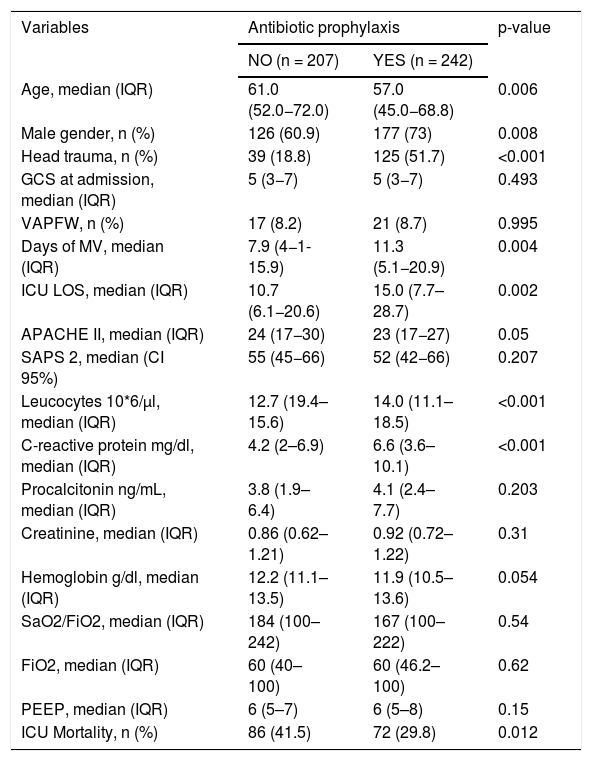
The characteristics of the patients included in the study are summarized in Table 1. Compared with the control group, those who received antibiotics were younger, more often male, and more likely to have head trauma (51.7% vs. 18.8%). They also had longer ICU stays, more days on mechanical ventilation (median 11.3 vs. 7.9), higher leukocyte counts and CRP levels, and lower ICU mortality (29.8% vs. 41.5%; p = 0.012). The incidence of VAPFW was similar in both groups (8.7% vs. 8.2%; p = 0.995). All other variables are presented in Table 1.
Characteristics of the 449 patients included according to the receipt of antibiotics prophylaxis or not.
| Variables | Antibiotic prophylaxis | p-value | |
|---|---|---|---|
| NO (n = 207) | YES (n = 242) | ||
| Age, median (IQR) | 61.0 (52.0−72.0) | 57.0 (45.0−68.8) | 0.006 |
| Male gender, n (%) | 126 (60.9) | 177 (73) | 0.008 |
| Head trauma, n (%) | 39 (18.8) | 125 (51.7) | <0.001 |
| GCS at admission, median (IQR) | 5 (3−7) | 5 (3−7) | 0.493 |
| VAPFW, n (%) | 17 (8.2) | 21 (8.7) | 0.995 |
| Days of MV, median (IQR) | 7.9 (4−1-15.9) | 11.3 (5.1−20.9) | 0.004 |
| ICU LOS, median (IQR) | 10.7 (6.1−20.6) | 15.0 (7.7–28.7) | 0.002 |
| APACHE II, median (IQR) | 24 (17−30) | 23 (17−27) | 0.05 |
| SAPS 2, median (CI 95%) | 55 (45−66) | 52 (42−66) | 0.207 |
| Leucocytes 10*6/µl, median (IQR) | 12.7 (19.4–15.6) | 14.0 (11.1–18.5) | <0.001 |
| C-reactive protein mg/dl, median (IQR) | 4.2 (2–6.9) | 6.6 (3.6–10.1) | <0.001 |
| Procalcitonin ng/mL, median (IQR) | 3.8 (1.9–6.4) | 4.1 (2.4–7.7) | 0.203 |
| Creatinine, median (IQR) | 0.86 (0.62–1.21) | 0.92 (0.72–1.22) | 0.31 |
| Hemoglobin g/dl, median (IQR) | 12.2 (11.1–13.5) | 11.9 (10.5–13.6) | 0.054 |
| SaO2/FiO2, median (IQR) | 184 (100–242) | 167 (100–222) | 0.54 |
| FiO2, median (IQR) | 60 (40–100) | 60 (46.2–100) | 0.62 |
| PEEP, median (IQR) | 6 (5–7) | 6 (5–8) | 0.15 |
| ICU Mortality, n (%) | 86 (41.5) | 72 (29.8) | 0.012 |
IQR: interquartile range 25-75; GCS: Glasgow coma scale; VAPFW: ventilator-associated pneumonia occurring in the first week; MV: mechanical ventilation; ICU: intensive care unit; LOS: length of stay; APACHE: acute physiology and chronic health evaluation; SAPS: simplified acute physiology score; SaO2: arterial oxygen saturation, FiO2: Inspired fraction of oxygen, PEEP: positive end expiratory pressure.
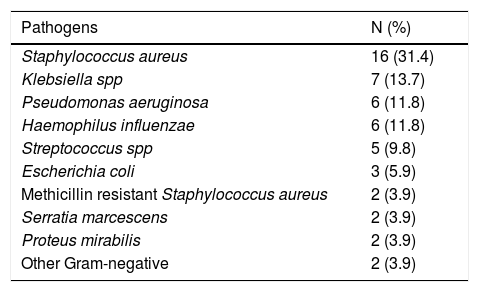
VAPFW was diagnosed in 38 patients (8.4%). A tracheal aspirate was perform to identify the causative germ in all the patients with VAPFW suspicion. A total of 51 microorganisms were isolated from the 38 patients. The most frequently isolated microorganisms were Staphylococcus aureus and Klebsiella spp. (see Table 2). In 34% of cases, the isolates were polymicrobial.
Fifty-one microorganisms pathogens isolated in respiratory samples of 38 patients diagnosed with early onset VAP. Note that in 13 patients (34%) the isolation was polymicrobial.
| Pathogens | N (%) |
|---|---|
| Staphylococcus aureus | 16 (31.4) |
| Klebsiella spp | 7 (13.7) |
| Pseudomonas aeruginosa | 6 (11.8) |
| Haemophilus influenzae | 6 (11.8) |
| Streptococcus spp | 5 (9.8) |
| Escherichia coli | 3 (5.9) |
| Methicillin resistant Staphylococcus aureus | 2 (3.9) |
| Serratia marcescens | 2 (3.9) |
| Proteus mirabilis | 2 (3.9) |
| Other Gram-negative | 2 (3.9) |
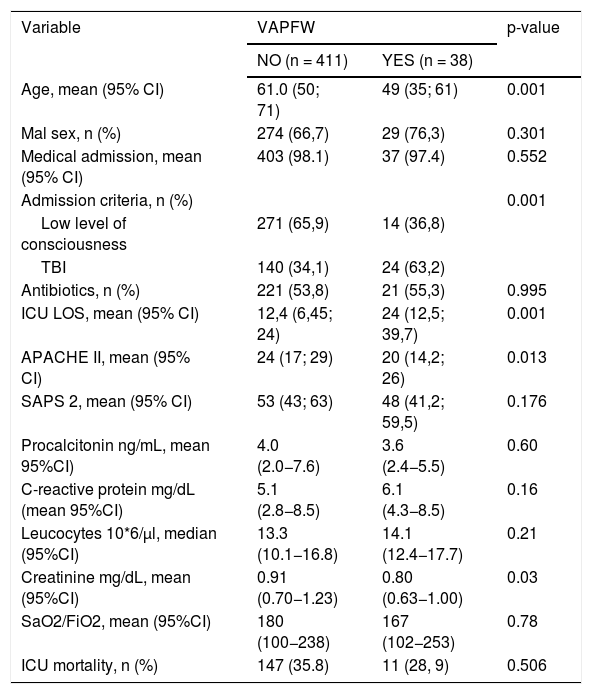
Compared with patients without VAPFW, those with VAPFW were younger and more frequently had traumatic brain injury as the reason for admission (63.2% vs. 34.1%; OR = 3.32, 95% CI 1.66–6.62; p = 0.001). They also had a substantially longer ICU stay and lower APACHE II scores.
ICU mortality was numerically lower in the VAPFW group (28.9% vs. 35.8%; p = 0.506), but this was not statistically significant. Other variables, including sex distribution, admission type, inflammatory markers, and SAPS II scores, are presented in Table 3.
Characteristics of patients according to the presence or absence of VAPFW.
| Variable | VAPFW | p-value | |
|---|---|---|---|
| NO (n = 411) | YES (n = 38) | ||
| Age, mean (95% CI) | 61.0 (50; 71) | 49 (35; 61) | 0.001 |
| Mal sex, n (%) | 274 (66,7) | 29 (76,3) | 0.301 |
| Medical admission, mean (95% CI) | 403 (98.1) | 37 (97.4) | 0.552 |
| Admission criteria, n (%) | 0.001 | ||
| Low level of consciousness | 271 (65,9) | 14 (36,8) | |
| TBI | 140 (34,1) | 24 (63,2) | |
| Antibiotics, n (%) | 221 (53,8) | 21 (55,3) | 0.995 |
| ICU LOS, mean (95% CI) | 12,4 (6,45; 24) | 24 (12,5; 39,7) | 0.001 |
| APACHE II, mean (95% CI) | 24 (17; 29) | 20 (14,2; 26) | 0.013 |
| SAPS 2, mean (95% CI) | 53 (43; 63) | 48 (41,2; 59,5) | 0.176 |
| Procalcitonin ng/mL, mean 95%CI) | 4.0 (2.0−7.6) | 3.6 (2.4−5.5) | 0.60 |
| C-reactive protein mg/dL (mean 95%CI) | 5.1 (2.8−8.5) | 6.1 (4.3−8.5) | 0.16 |
| Leucocytes 10*6/µl, median (95%CI) | 13.3 (10.1−16.8) | 14.1 (12.4−17.7) | 0.21 |
| Creatinine mg/dL, mean (95%CI) | 0.91 (0.70−1.23) | 0.80 (0.63−1.00) | 0.03 |
| SaO2/FiO2, mean (95%CI) | 180 (100−238) | 167 (102−253) | 0.78 |
| ICU mortality, n (%) | 147 (35.8) | 11 (28, 9) | 0.506 |
VAPFW: Ventilator associated pneumonia; occurring in the first week; CI: confidence interval; TBI: trauma brain injury; ICU: intensive care unit; LOS: length of stay; APACHE: Acute Physiology and Chronic Health disease; SAPS: Simplified Acute Physiology Score, SaO2: arterial oxygen saturation, FiO2: Inspired fraction of oxygen.
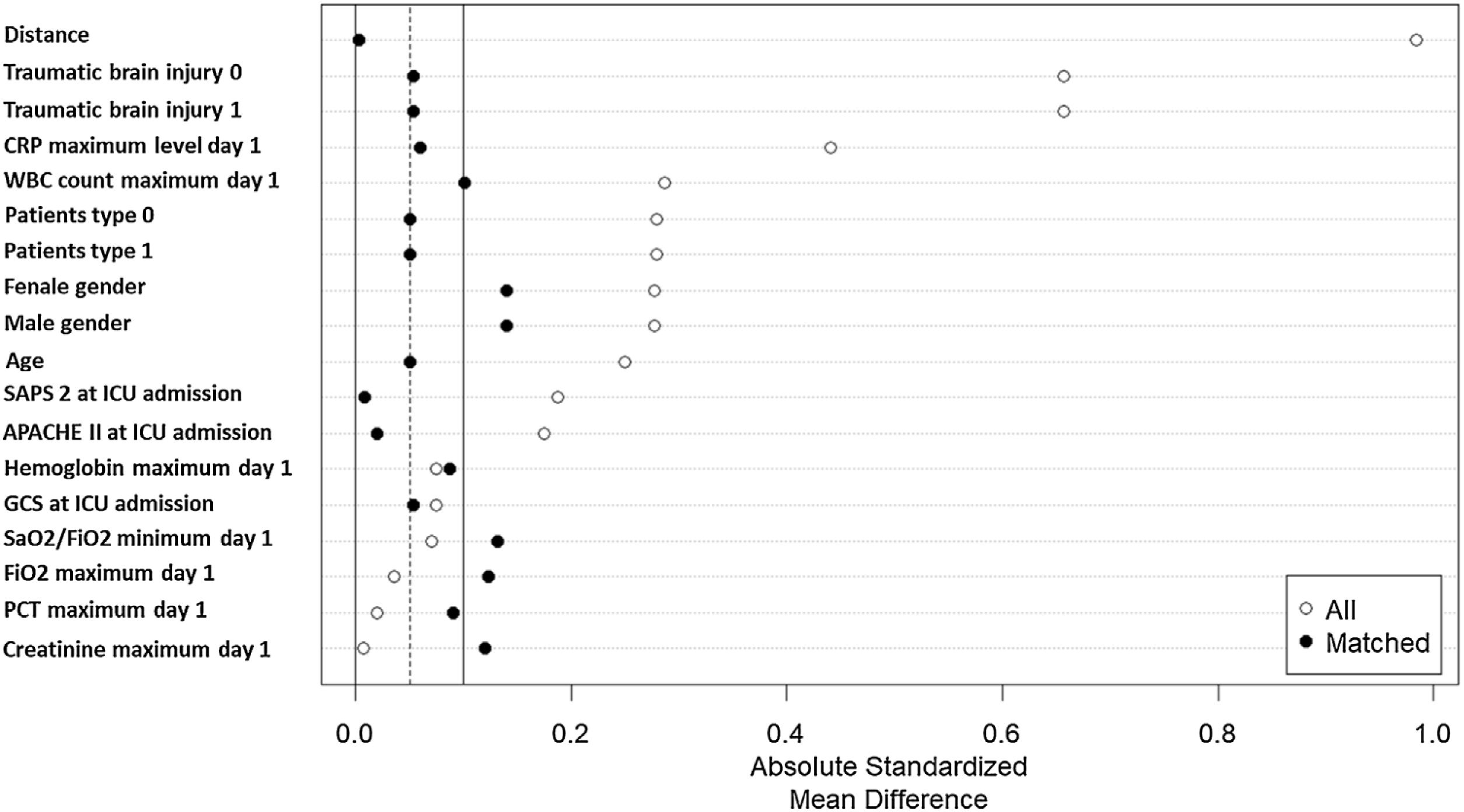
After propensity score matching, 206 patients in the control group were matched to 242 patients in the antibiotic group, with only one patient excluded from the initial cohort due to missing data (Fig. 1).
Love graph of the absolute standardized difference for each covariate in the original and matched data. The second vertical line indicates the equilibrium threshold at 0.1. (APACHE: Acute Physiology and Chronic Health disease; SAPS: Simplified Acute Physiology Score; GCS: Glasgow coma scale; SaO2: arterial oxygen saturation; FiO2: Inspired fraction of oxygen; PCT: procalcitonin).
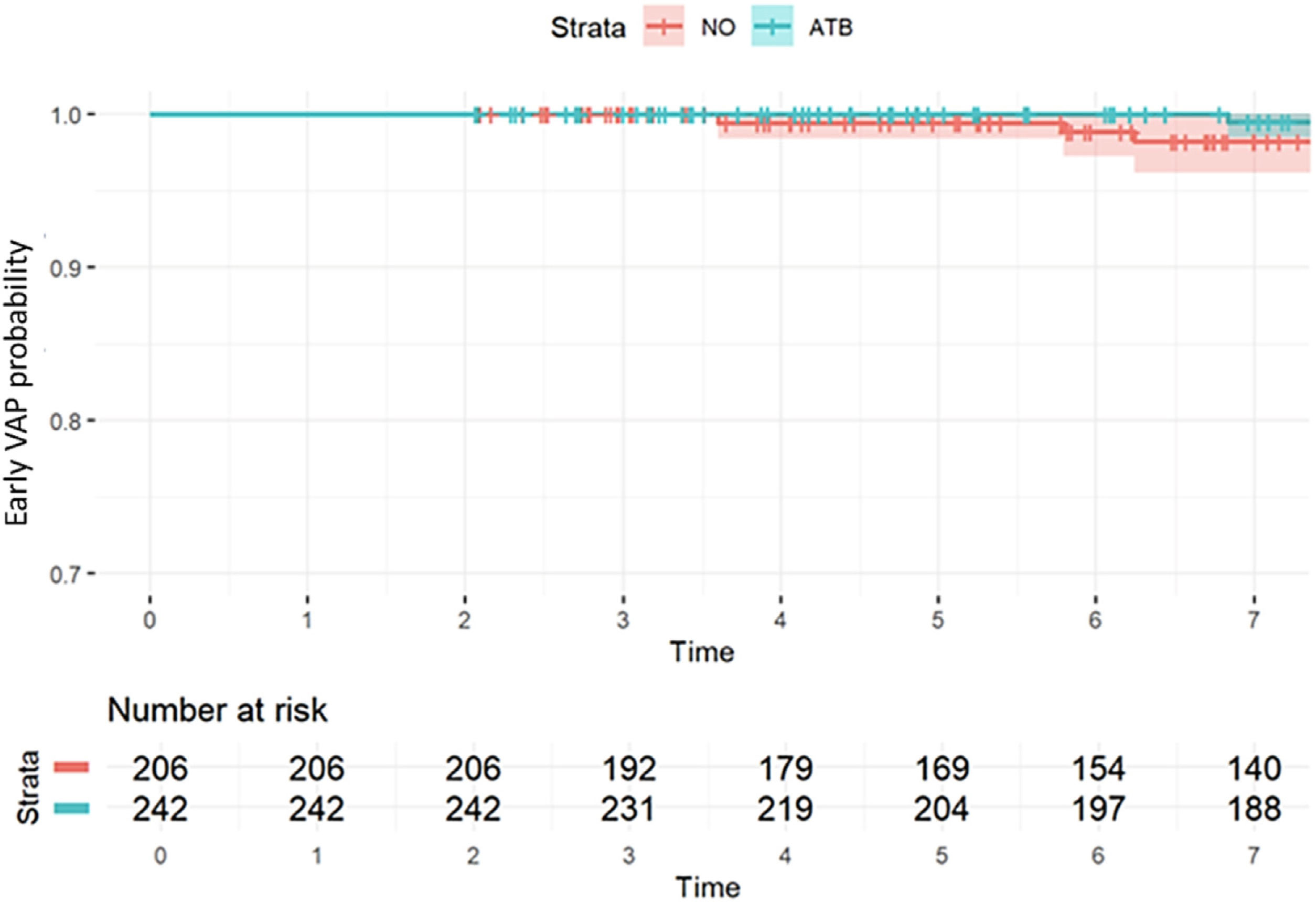
Kaplan–Meier survival analysis demonstrated no statistically significant difference in the cumulative incidence of VAPFW between groups (log-rank p > 0.05; Fig. 2). In the Cox proportional hazards model, however, antibiotic administration was associated with a 62% lower proportional daily risk of developing VAPFW (HR = 0.38; 95% CI 0.17–0.83).
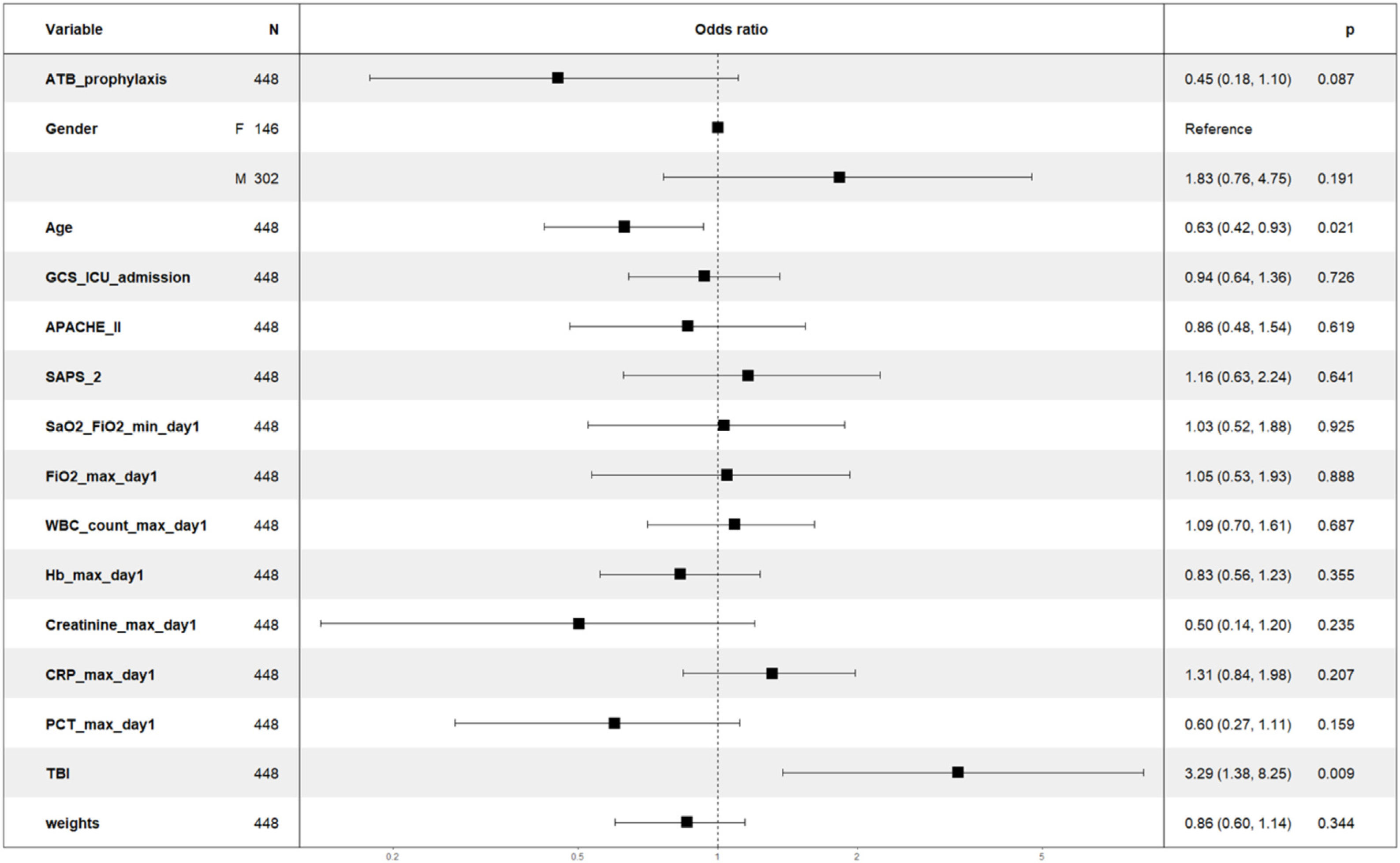
This apparent protective effect was not confirmed in the multiple logistic regression model (OR = 0.45; 95% CI 0.18–1.10; p = 0.08), although a trend toward reduced risk persisted. In the fully adjusted analysis, only younger age and cranial trauma as the reason for ICU admission were independently associated with VAPFW (Fig. 3).
Variables independently associated with the development of VAPFW in multivariate regression analysis (GLM). (ATB: antibiotic; APACHE: Acute Physiology and Chronic Health disease; SAPS: Simplified Acute Physiology Score; GCS: Glasgow coma scale; SaO2: arterial oxygen saturation; FiO2: Inspired fraction of oxygen; WBC: white blood cells; CRP: C-reactive protein; PCT: procalcitonin, TBI: Traumatic brain injury).
To our knowledge, this is the first study to use real-world ICU data to evaluate the impact of prophylactic antibiotic administration in patients intubated for low levels of consciousness. After adjustment with propensity score matching and Cox regression, antibiotic prophylaxis was associated with a significantly lower proportional daily risk of developing early ventilator-associated pneumonia (VAP). However, this association was not confirmed in the cumulative incidence analysis (Kaplan–Meier) or in the multiple logistic regression model, where the effect did not reach statistical significance.
These findings contrast with several previous studies, both randomized trials and observational analyses, which generally reported a protective effect of prophylactic antibiotics in this patient population. Acquarolo et al.,13 in a single-centre randomized trial, observed that a three-day course of ampicillin–sulbactam reduced the relative risk of VAPFW by 65% in patients with a Glasgow Coma Scale (GCS) ≤8 (21% vs. 57.9%, p = 0.02). Vallés et al.,12 in an observational study, found that a single 2 g dose of ceftriaxone within 4 h of intubation lowered VAPFW incidence from 22.4% to 2.8% (p = 0.01). More recently, the multicentre randomized PROPHY-VAP trial11 included 345 patients with a GCS ≤ 8 who required mechanical ventilation for more than 48 h and were randomized to receive either a single dose of ceftriaxone or placebo within 12 h of admission. Those who received antibiotics experienced a lower incidence of VAPFW (14% vs. 32%; HR 0.6, 95% CI 0.38–0.95; p = 0.03) and a reduction in VAP at any time during ICU stay (20% vs. 36%; HR 0.62, 95% CI 0.42–0.95).
The results of these individual studies have been reinforced by multiple meta-analyses. Righy et al.16 reported that systemic prophylactic antibiotic treatment reduced the incidence of VAPFW by 68% (RR 0.32, 95% CI 0.19–0.54) and shortened ICU length of stay by 32%. Ehrenzeller et al.17 found a reduced VAPFW risk in severe traumatic brain injury (TBI) patients (RR 0.61, 95% CI 0.47–0.78) but no effect on ICU length of stay, mechanical ventilation days, or mortality. Prieto-Alvarado et al.18 identified prophylactic antibiotics as a protective factor against VAP in TBI patients (OR 0.67, 95% CI 0.51–0.88; p ≤ 0.05). Meregildo-Rodríguez et al.,19 focusing exclusively on β-lactam antibiotics, demonstrated a 57% reduction in VAPFW risk (RR 0.43, 95% CI 0.30–0.61) and a 35% reduction in all VAP cases (RR 0.65, 95% CI 0.53–0.80), but no effect on late-onset VAP or 28-day mortality. Recently, Hadley-Brown et al.20 have published a new meta-analysis, showing and association between prophylactic antibiotic administration and reduced VAP incidence (RR 0.53, CI 95% 0.35−0.89), but heterogeneity of the results is moderate (I2 = 52%) and certainty was adjudicated to be low.
In contrast, our findings are more closely aligned with those of Robba et al.,21 who studied 962 patients with TBI ventilated for more than 48 h and found no significant difference in prophylaxis use between patients who developed VAP and those who did not (72.1% vs. 66.3%, p = 0.14). Nonetheless, their Cox regression analysis revealed a modest reduction in VAP risk associated with prophylaxis (HR 0.69, 95% CI 0.50–0.96).
One important factor that may explain the discrepancies between our results and previous literature is the baseline incidence of VAPFW. While prior trials and observational studies reported rates ranging from 11% to 40%,10–13 the incidence in our cohort was only 8%. This lower rate is likely attributable to the consistent application of prevention strategies, such as the Neumonía Zero project14 and internationally recommended ventilator care bundles,15 in our ICU. These measures have been shown to substantially reduce VAP rates, and in such a low-incidence context, the absolute benefit of antibiotic prophylaxis may be too small to achieve statistical significance. Conversely, in high-incidence settings, the same intervention could produce a clinically meaningful risk reduction.
Our findings also reinforce the substantial risk of VAPFW in patients with TBI, a relationship that has been consistently documented. Brain injury–induced immunosuppression, characterized by impaired T-cell function, reduced cytokine production,22,23 decreased natural killer cell numbers and cytotoxic activity,24 monocyte inactivation, and diminished granulocyte phagocytic capacity,25,26 contributes to this susceptibility. Clinical factors such as chest trauma, barbiturate use to control intracranial hypertension, transfusion at admission, high trauma severity scores, and delayed enteral nutrition in severe subarachnoid hemorrhage27–29 further increased risk. This high-risk profile underscores the importance of intensive, targeted preventive strategies in TBI patients, combining non-pharmacological measures with judicious evaluation of antibiotic prophylaxis in accordance with local epidemiology and stewardship policies.
In out cohort, antibiotics at intubation were administered only when indicated for other reasons (e.g., surgical prophylaxis, scalp injuries, open fractures). When the SEMICYUC “Neumonía Zero” project was launched, prophylactic antibiotic administration to intubated patients with a low level of consciousness was not considered mandatory, and consequently, our unit decided not to adopt it. In the latest revision of the bundle, this measure has been changed to mandatory. Given our low incidence of ventilator-associated pneumonia in the first week, we have decided for the time being to maintain the measures we initially adopted, excluding prophylactic antibiotic therapy. Our results seem to reinforce our decision.
Several limitations should be considered when interpreting these findings. First, this study was observational and retrospective. Although propensity score matching was applied to minimize baseline differences, unmeasured confounders and residual bias cannot be ruled out. The lack of randomization means that causality cannot be established with certainty, and results should therefore be interpreted with caution.
Second, the low incidence of VAPFW in our ICU, while desirable from a patient care perspective, may have reduced the statistical power to detect differences attributable to the intervention. These results may not be generalizable to ICUs with higher VAPFW rates, where the potential impact of prophylaxis could be more pronounced.
Third, our patient population included individuals with low levels of consciousness from a range of etiologies, including TBI, ischaemic and haemorrhagic stroke, and post-neurosurgical states. This heterogeneity may limit comparability with studies focusing on homogeneous TBI cohorts. However, it reflects real-world ICU practice, where critically ill patients present with diverse neurological injuries.
Finally, while all VAP cases were microbiologically confirmed, retrospective data collection limits our ability to fully account for variations in diagnostic practice, sampling frequency, or clinical thresholds for obtaining cultures. Nonetheless, the requirement for microbiological confirmation reduces the likelihood of substantial misclassification.
In conclusion, in ICUs with a low baseline incidence of VAPFW, the routine administration of prophylactic antibiotics to patients intubated for low levels of consciousness does not appear to confer a meaningful reduction in VAP risk. Given the importance of antimicrobial stewardship and the potential for promoting resistance, our findings support avoiding this practice in favour of sustained application of evidence-based VAP prevention bundles. Future prospective multicentre studies in settings with varying baseline VAP incidence are warranted to better define the patient populations and epidemiological contexts in which prophylactic antibiotic use might yield a net clinical benefit.
CRediT authorship contribution statementConceptualization, Laura Claverias and Alejandro Rodríguez; Formal analysis, Julen Berrueta, Alejandro García-Martínez, Pau Orts and Josep Gómez; Funding acquisition, Alejandro Rodríguez; Investigation, Laura Claverias, Romina Martínez and Sara Manrique; Methodology, Julen Berrueta and Alejandro Rodríguez; Writing – original draft, Laura Claverias and Romina Martínez; Writing – review & editing, María Bodí, Juan J. Guardiola, Ignacio Martín-Loeches and Alejandro Rodríguez. All authors have read and agreed to the published version of the manuscript.”
Declaration of Generative AI and AI-assisted technologies in the writing processNo AI-assisted tools were used in the preparation of this manuscript.
FundingThis study was supported with protected research time (AR and MB) by a grant from the Ricardo Barri Casanovas Foundation (FRBC01/2024). The sponsors were not involved in the study design, data collection, data analysis, data interpretation, or report writing.
The authors declare no conflicts of interest.
We express our gratitude to the dedicated staff members of the Intensive Care, and ICU Nursing Departments at Hospital Universitari Joan XXIII. This project would not have been possible without their collaborative efforts. The authors have reviewed and edited the output and take full responsibility for the content of this publication.