

Venous thromboembolism (VTE), encompassing deep vein thrombosis and acute pulmonary embolism, represents a common and potentially fatal complication in the intensive care unit (ICU), leading to increased morbidity and mortality. A recent systematic review and meta-analysis among 27,344 ICU patients reported a pooled VTE prevalence of 10 % in a mixed cardiovascular, surgical, medical, trauma and neurosurgical ICU population.1 According to several clinical practice societal guidelines for VTE prophylaxis among ICU patients, low molecular weight heparins (LMWH) is generally the preferred agent over unfractionated heparins (UFH), since it has been demonstrated that LMWH reduces VTE (OR, 0.72 [95% CI, 0.46−0.98]), probably reducing heparin-induced thrombocytopenia with similar rates of clinically relevant bleeding2; however, ICU patients have shown significant variability and rapid changes in their antithrombotic pharmacokinetic, pharmacodynamics due to a variety of clinical factors like liver, renal function, fluid shifts, ongoing continuous pro-inflammatory states, and in some patients, short-term mechanical circulatory support (MCS) (e.g. sepsis, septic shock, COVID-19, severe trauma, burns, aggressive invasive support like extracorporeal membrane oxygenation [ECMO], central venous catheters, blood flow pumps etc.); therefore, utilizing only one type of anticoagulation agent, like heparins should not be generalizable nor “one size fits all” approach; moreover, LMWH and UFH are not exempt from significant bleeding risks, nor the particular clinical profile of a given ICU patient, in which there is always an evolving and ongoing dynamic shifts between thromboembolic and bleeding complications, putting at risk patients’ outcomes.3,4
Decisions while choosing optimal anticoagulation strategies for VTE prophylaxis in ICU patients must always balance both thromboembolic and bleeding risks. While LMWH and UFH currently represent the default anticoagulant of choice in ICU, newer antithrombotic agents, like different classes of factor XI/XIa inhibitors, have emerged as an attractive compound, being able to prevent and treat VTE, while simultaneously minimizing significant bleeding risks.5 Factor XI/XIa plays a critical role in the contact (intrinsic) pathway while promoting the formation of pathological thrombosis, with significant amplification, and subsequent growth of endovascular thrombi; in contrast, factor XI has very modest role in hemostasis, minimizing anticoagulation-associated bleeding complications.5 Factor XI is the precursor of FXIa, a serine protease primarily synthesized in the liver; factor XI could be activated to FXIa by thrombin, activated FXII, negatively charge polyphosphates released from platelets, promote autoactivation of FXII, enhancing FXI activation. In situations in which thrombosis is initiated by the exposure of blood from artificial surfaces (e.g. endovascular catheters/devices), factor XI gets activated via FXIIa.5 Compared to patients with normal levels of factor XI, patients with factor XI deficiency (hemophilia type C [Rosenthal disease]) have shown to be decreased incidence of major cardiovascular events like ischemic stroke, and VTE.5 In a recent phase 2 clinical trial, gruticibart (Xisomab 3G3), a humanized monoclonal-antibody against factor XI/XIa, was evaluated in the prevention of catheter-associated thrombosis in patients with cancer; a single dose at 2 mg/kg was administered through the catheter within 24 h of placement. The overall incidence of thrombosis was in the gruticibart group at 14 days (12.5% vs 40% in usual care), being well tolerated and without any bleeding complications; however, an important caveat to consider in this phase 2 study was that it was very small, including only 22 patients in total, 11 being in the factor XI/XIa inhibitor arm.6
Promising phase 2 clinical trials with factor XI/XIa inhibitors for VTE prevention in different subgroups like post total knee replacement major orthopedic surgery, prevention of catheter-associated VTE and end-stage renal disease have demonstrated acceptable efficacy and safety profiles; however, large scale, head to head, phase 3, randomized clinical trials are still undergoing and yet to be completed, in order to draw more robust, and solid conclusions, replicating such promising results from earlier phase 2 clinical trials, since the latter were designed mainly to assess safety (bleeding risk) rather than efficacy (VTE events).5
Since safer anticoagulation strategies are currently being investigated to reduce the incidence of thrombosis and bleeding in percutaneous MCS, FXI/XIa inhibition through the contact pathway could be extremely beneficial, representing an excellent opportunity to explore in future prospective studies, especially in patients being supported with percutaneous MCS like ECMO, endovascular cannulas or intracardiac devices (e.g. left or right percutaneous ventricular assist devices [pVADs] like Impella), which are currently commonly utilized in comprehensive cardiovascular and respiratory ICUs, since FXI is strongly activated by these negatively charged artificial, non-biological surfaces.4,5,7
Pollack et al. reported initial pharmacokinetic and pharmacodynamic data of an intravenous, short-acting, selective, small molecule, FXI/XIa inhibitor (EP-7041) in a canine model of VV-ECMO, demonstrating that EP-7041 prevented increases in oxygenator resistance without impairing hemostasis; EP-7041 appears to be well suited for use in the ICU setting.8 Tweddell et al. showed that FXI inhibition completely prevented the increase in thrombin generation driven by membrane oxygenator fibers (MOFs), suggesting MOFs augment thrombin-mediated FXI activation, concluding that FXI inhibition can mitigate thrombosis, prolong ECMO lifespan, and prevent fibrinogen consumption in the rabbit ECMO model.9
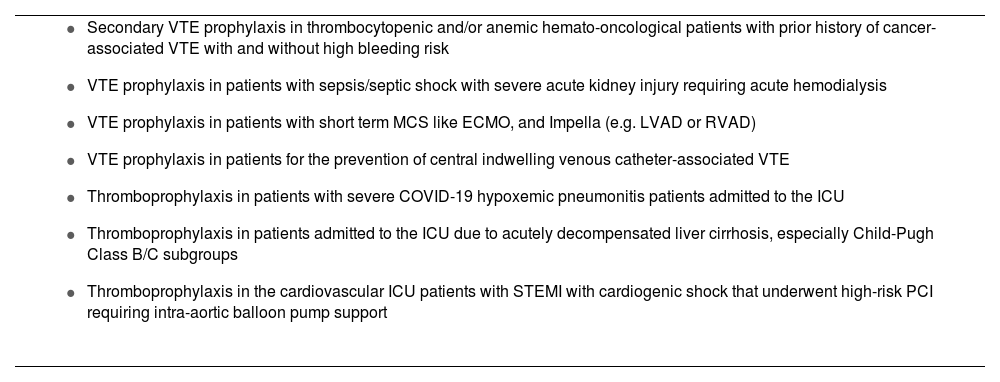
To our knowledge, there is only one ongoing phase 2, open-label, COVID-19 thromboprophylaxis study (NCT05040776), that will evaluate safety and tolerability of frunexian [EP-7041] in patients with severe hypoxemic COVID-19 pneumonitis in the ICU. The trial will follow 2 consecutive phases. First, 30 patients will be randomized to 0.6 or 1.0 mg/kg IV per hour for the duration of the hospitalization and will be followed up for adverse events up to 7 days post-discharge. In a subsequent phase, 60 patients will be randomized in a 2:1 fashion to the best dose of frunexian emerged from the phase 1 study versus standard of care.10Table 1 outlines a select subgroup of ICU patients in which it may be reasonable to assess safety and efficacy of factor XI/XIa inhibitors in the future.
Future research agenda in selected ICU patients exploring efficacy and safety of factor XI/XIa inhibitors for VTE prophylaxis.
|
Abbreviations: VTE, venous thromboembolism; MCS, mechanical circulatory support; ECMO, extracorporeal membrane oxygenation; LVAD, Left ventricular assist devices; RVAD, Right ventricular assist devices.
We believe that it is now the time to move forward with FXI/XIa inhibitors in the ICU arena. We would like to highlight the specific unmet needs and further research is needed, and must be addressed in large-scale, phase 3 clinical trials, providing valuable information from this novel class of antithrombotic drugs, exploring them in diverse complex ICU clinical scenarios, with the goal to incorporate them in our clinical practice.
CRediT authorship contribution statementAll the authors have contributed equally and substantially by writing, editing, reviewing the evidence data and finalizing the document, thus deserving authorship.
Declaration of Generative AI and AI-assisted technologies in the writing processNonuse of some form of AI.
FundingNone.
None.