

Our extracorporeal membrane oxygenation (ECMO) team receives a call from a major sporting event in Barcelona: “We have an out-of-hospital cardiac arrest (OHCA). A 60-year-old man, no comorbidities. Ventricular fibrillation. Immediate initiation of cardiopulmonary resuscitation (CPR), but no return of spontaneous circulation (ROSC) after 25minutes. We believe he is a candidate for extracorporeal cardiopulmonary resuscitation (ECPR).”
The use of ECMO in CPR —known as ECPR—has gained remarkable momentum in recent years. Three randomized clinical trials published between 2020 and 2023 have provided relevant evidence in this field.1 Among the variables most strongly influencing prognosis, low-flow time—defined as the interval between cardiac arrest and establishment of adequate extracorporeal blood flow—stands out.2
Minimizing this interval is critical, as it directly impacts neurological outcomes. Chest compressions, while essential, provide limited cerebral and coronary perfusion. In contrast, extracorporeal flow enables effective perfusion: more than 90% of patients achieve ROSC after ECMO initiation. Nevertheless, mortality remains high, mainly due to two causes: refractory multiple organ failure and irreversible neurological damage.3
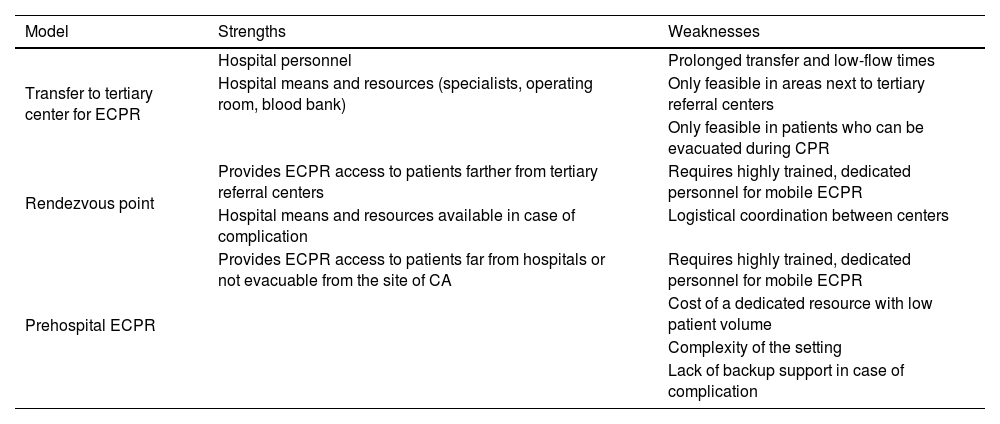
The optimal model for delivering ECPR has not yet been established. Currently, 3 international models exist (Table 1).4 In Spain, ECPR programs remain scarce and are largely limited to in-hospital cannulation,3 restricting access for many patients. For this reason, teams across different countries have developed out-of-hospital ECPR programs. By deploying ECPR teams directly to the site of cardiac arrest, low-flow times can be drastically reduced. However, this approach entails major logistical, economic, and organizational challenges that have thus far limited widespread implementation.5
Models of out-of-hospital cardiac arrest care using ECPR.
| Model | Strengths | Weaknesses |
|---|---|---|
| Transfer to tertiary center for ECPR | Hospital personnel | Prolonged transfer and low-flow times |
| Hospital means and resources (specialists, operating room, blood bank) | Only feasible in areas next to tertiary referral centers | |
| Only feasible in patients who can be evacuated during CPR | ||
| Rendezvous point | Provides ECPR access to patients farther from tertiary referral centers | Requires highly trained, dedicated personnel for mobile ECPR |
| Hospital means and resources available in case of complication | Logistical coordination between centers | |
| Prehospital ECPR | Provides ECPR access to patients far from hospitals or not evacuable from the site of CA | Requires highly trained, dedicated personnel for mobile ECPR |
| Cost of a dedicated resource with low patient volume | ||
| Complexity of the setting | ||
| Lack of backup support in case of complication |
ECPR: extracorporeal cardiopulmonary resuscitation; CA: cardiac arrest; CPR: cardiopulmonary resuscitation.
In this context, events with large crowds—such as marathons, festivals, or sporting competitions—represent an especially favorable setting for the strategic deployment of on-site ECPR. The incidence rate of cardiac arrest is not negligible, and the presence of trained teams capable of providing immediate extracorporeal support makes both clinical and operational sense. Unlike generalized deployment, these events provide a bounded and predictable logistical framework, with defined access routes, routine presence of emergency services, and a population profile that in many cases meets ECPR criteria. The deployed team must be properly trained, equipped with the necessary resources, and operate under a protocol coordinated with emergency services and ECMO referral centers. In addition, preparation must follow current international recommendations and be subject to expert oversight to ensure safety and efficacy.
Returning to the call: “Our ECPR team could be ready to cannulate in the emergency department in 5minutes.” The reply from the event site: “We will need about 20minutes to put him in the ambulance, and then at least 30 more minutes to drive him to the hospital.” The immediate response: “You will arrive with a low-flow time greater than 75minutes; he will no longer be eligible for ECPR.” Silence. Finally, one last question: “Should we activate him as a potential uncontrolled donation after circulatory death donor?”
The moment to intervene was earlier. And that earlier, in certain contexts, requires the ability to bring ECMO to the site of the cardiac arrest.
CRediT authorship contribution statementEduard Argudo: conceptualization; drafting of the original manuscript; drafting, review, and editing; approval of the final version.
María Vidal-Burdeus and Jorge Morales-Álvarez: drafting, review, and editing; approval of the final version.
Jordi Riera: conceptualization; supervision; drafting of the original manuscript; writing, review, and editing; approval of the final version.
Declaration of Generative AI and AI-assisted technologies in the writing processThe authors declare that no AI tools were used in the preparation of this manuscript.
FundingNone declared.
None declared.