

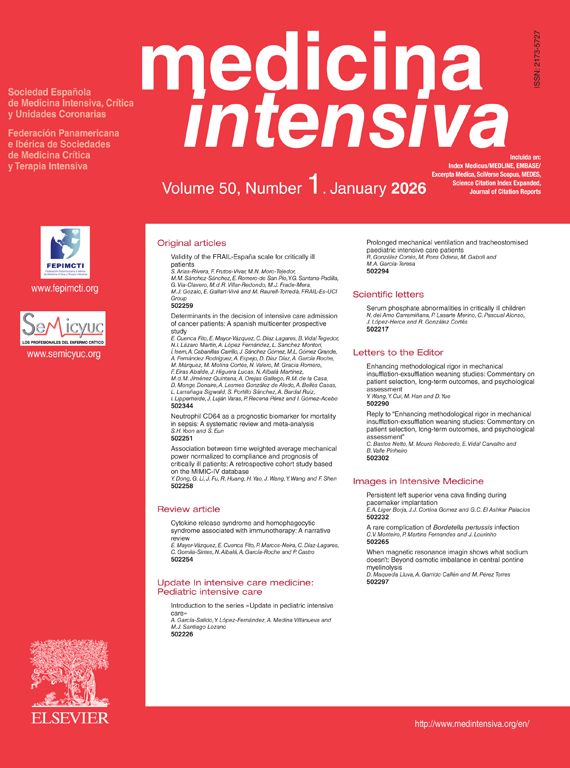

Article information
Special issue
This article is part of special issue:
The neurocritical patient
Edited by: Juan Antonio Llompart-Pou - Specialist in Intensive Care Medicine, Doctorate in Health Sciences, Universitat Illes Balears. Department of Intensive Care Medicine, Trauma and Neurocritical ICU, Hospital Universitari Son Espases. Palma, Spain
Last update: November 2025
More infoArticle
These are the options to access the full texts of the publication Medicina Intensiva (English Edition)
Member
If you are a member of the Sociedad Española de Medicina Intensiva, Crítica y Unidades Coronarias::
Go to the members area of the website of the SEMICYUC (www.semicyuc.org )and click the link to the magazine.
Go to the members area of the website of the SEMICYUC (www.semicyuc.org )and click the link to the magazine.
Purchase